
Board Certified Tampa
DUI Defense Expert
DUI Defense Expert



By W.F. “Casey” Ebsary Jr. | DUI2GO.com
If you have been charged with DUI with serious bodily injury or DUI property damage in Florida, you are no longer dealing with a routine DUI case. I handle these cases regularly, and I can tell you that once an accident is involved—especially one involving injuries—the legal consequences escalate quickly.
Under Florida Statute § 316.193, DUI offenses involving injury or property damage are treated far more seriously than standard DUI cases. The State begins to focus not just on impairment, but on causation, liability, and the extent of harm.
👉 View the statute here: https://www.leg.state.fl.us/statutes/index.cfm?App_mode=Display_Statute&URL=0300-0399%2F0316%2FSections%2F0316.193.html
If you are facing one of these charges, I encourage you to act quickly:
👉 Contact me: https://dui2go.com/contact/
👉 Learn more about my background: https://dui2go.com/about/
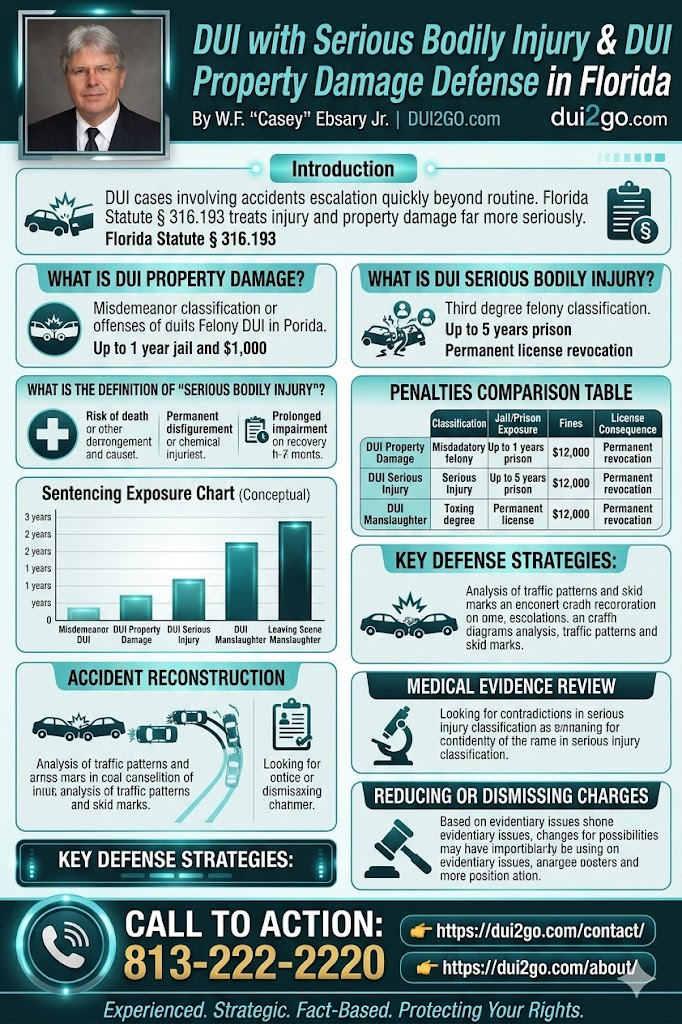
DUI with property damage is often the starting point for accident-based DUI charges. I explain to clients that this charge applies when a person is allegedly driving under the influence and causes damage to another person’s property or vehicle.
Even though it may sound minor compared to injury cases, this is still a criminal offense. In Florida, DUI property damage is typically charged as a first-degree misdemeanor, punishable by up to one year in jail and significant fines.
In my experience, these cases often hinge on whether the State can prove that impairment actually caused the accident—not just that the driver had alcohol in their system.
DUI with serious bodily injury is a major escalation from property damage cases. Under Florida law, this charge applies when a DUI crash results in serious bodily injury to another person.
The term “serious bodily injury” is defined broadly and can include injuries that create a substantial risk of death, cause permanent disfigurement, or result in long-term loss of bodily function.
This offense is charged as a third-degree felony, exposing a defendant to up to five years in prison, along with fines and long-term license consequences. From my perspective, these cases are aggressively prosecuted because they involve real victims and significant harm.
The definition of serious bodily injury is critical because it determines whether a case is charged as a misdemeanor or a felony. Florida law looks at whether the injury involves a substantial risk of death, serious personal disfigurement, or prolonged impairment.
I often see disputes arise over whether an injury truly meets this legal threshold. Not every broken bone or hospital visit qualifies as “serious bodily injury,” and challenging that classification can be an important part of the defense.
Medical records, expert testimony, and timelines of recovery often play a key role in these cases.
The penalties for DUI with serious bodily injury are severe and can permanently affect your life. If convicted, you face felony-level consequences.
Under Florida law, penalties include:
Unlike DUI manslaughter, there is no mandatory minimum prison sentence, but judges often impose significant penalties depending on the circumstances.
What penalties apply to DUI Property Damage?
DUI property damage carries less severe penalties, but it should not be underestimated. A conviction can still result in jail time, probation, and a permanent criminal record.
Typical penalties include:
In my practice, I often focus on minimizing long-term consequences, including avoiding a conviction where possible.
What must the State prove in these cases?
In both DUI property damage and DUI with serious bodily injury cases, the State must prove more than just impairment.
First, they must show that the defendant was driving or in actual physical control of a vehicle while impaired or over the legal limit. Second, they must prove that the defendant caused or contributed to the accident.
This causation element is where many cases are successfully defended. I frequently work with accident reconstruction experts to determine whether another driver, road conditions, or other factors played a role in the crash.
How is causation challenged in DUI accident cases?
Causation is often the most important issue in these cases. Just because someone was impaired does not mean they caused the accident.
I examine every detail, including traffic patterns, vehicle damage, skid marks, and witness statements. In many cases, there are multiple contributing factors, and the law requires the State to prove that the defendant’s impairment actually contributed to the crash.
This is where expert testimony can make a significant difference in the outcome.
Can DUI property damage be reduced or dismissed?
Yes, depending on the facts of the case. I have handled cases where DUI property damage charges were reduced to reckless driving or dismissed entirely due to evidentiary issues.
Common weaknesses include lack of proof of impairment, unreliable breath test results, or insufficient evidence of causation. Early intervention is often key to achieving these outcomes.
Can DUI with Serious Bodily Injury be reduced?
These cases are more difficult to reduce, but it is possible under the right circumstances. If the evidence of serious bodily injury is weak, or if causation is disputed, the charge may be reduced to a lesser offense.
I approach these cases by analyzing medical records, consulting experts, and challenging the State’s narrative wherever appropriate.
| Offense | Classification | Jail/Prison Exposure | Fines | License Consequence |
| DUI Property Damage | 1st Degree Misdemeanor | Up to 1 year | Up to $1,000 | Suspension |
| DUI Serious Bodily Injury | 3rd Degree Felony | Up to 5 years | Up to $5,000 | Revocation |
| DUI Manslaughter | 2nd Degree Felony | Up to 15 years | Up to $10,000 | Permanent revocation |
| DUI Property Damage | ■■ |
| DUI Serious Injury | ■■■■■ |
| DUI Manslaughter | ■■■■■■■■■■■■■■ |
Yes. Even a minor accident involving another vehicle or property can lead to a DUI property damage charge. I have seen cases filed for relatively small amounts of damage, especially when law enforcement believes impairment was involved.
You can still be charged, but that does not mean you will be convicted. The State must prove that your impairment caused or contributed to the crash. I often challenge this element using expert analysis and evidence review.
It is possible, but not guaranteed. Unlike DUI manslaughter, there is no mandatory minimum prison sentence. However, the seriousness of the injuries often influences sentencing decisions.
Yes. Both offenses can result in license suspension or revocation. The severity depends on the charge and whether there are prior DUI convictions.
It is critical. These are not simple DUI cases—they involve accident reconstruction, medical evidence, and complex legal issues. I begin working immediately to preserve evidence and build a defense strategy.
When I take on a DUI injury or property damage case, I act quickly to gather evidence, interview witnesses, and consult with experts. These cases can evolve rapidly, and early intervention can significantly affect the outcome.
Waiting can mean losing valuable evidence that could support your defense.
If you or a loved one is facing DUI with serious bodily injury or DUI property damage, I am here to help.
👉 Contact me now: https://dui2go.com/contact/
👉 Learn more about my experience: https://dui2go.com/about/
The sooner we begin working on your case, the more opportunities we may have to protect your future.