- Free Consultation: 813.222.2220 Tap Here To Call Us




Video: Florida DUI Manslaughter Cases and THC Evidence


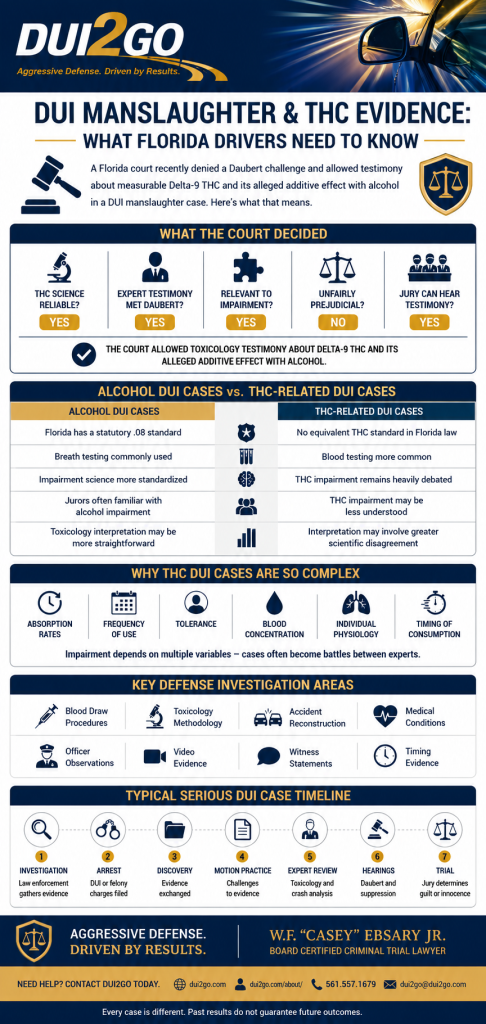
A recent Florida DUI manslaughter case involving allegations of alcohol impairment and measurable Delta-9 THC in the driver’s blood has raised major questions about scientific evidence, toxicology testimony, and the admissibility of marijuana-related evidence in criminal court. The trial court denied a defense challenge seeking to exclude testimony from a toxicologist concerning the effects of Delta-9 THC and its alleged interaction with alcohol.
The court’s ruling focused on whether the scientific testimony met Florida’s Daubert reliability standard and whether the jury should hear evidence concerning THC impairment. Importantly, the court emphasized that the State still bears the burden of proving impairment beyond a reasonable doubt.
At the same time, the ruling illustrates an important issue facing many DUI defendants in Florida: prosecutors increasingly rely on toxicology experts to explain alleged impairment involving substances other than alcohol. These cases can become highly technical and often require extensive litigation over scientific evidence, laboratory methodology, toxicology interpretation, and causation.
If you or someone you care about is under investigation for DUI manslaughter, DUI involving controlled substances, or a serious felony DUI charge in Florida, speaking with an experienced DUI defense attorney immediately may be critical.
Learn more about the defense approach used by the Law Office of W.F. “Casey” Ebsary Jr. at DUI2Go.com or review attorney credentials and background at About W.F. Casey Ebsary Jr..
Understanding the Court’s Ruling
The court addressed whether the prosecution could introduce evidence that the defendant allegedly had measurable Delta-9 THC in her blood at the time of the crash.
According to the order, the court concluded:
| Issue Before Court | Court’s Finding |
|---|---|
| Whether Delta-9 THC science is sufficiently reliable | Court said yes |
| Whether expert testimony met Daubert standards | Court said yes |
| Whether THC evidence was relevant to impairment | Court said yes |
| Whether evidence was unfairly prejudicial | Court said no |
| Whether a jury could hear toxicology testimony | Court allowed testimony |
The ruling specifically discussed:
- Delta-9 THC as the active impairing substance in marijuana
- The alleged additive effect between alcohol and THC
- The absence of a universally accepted THC impairment threshold
- Whether toxicology testimony would assist the jury
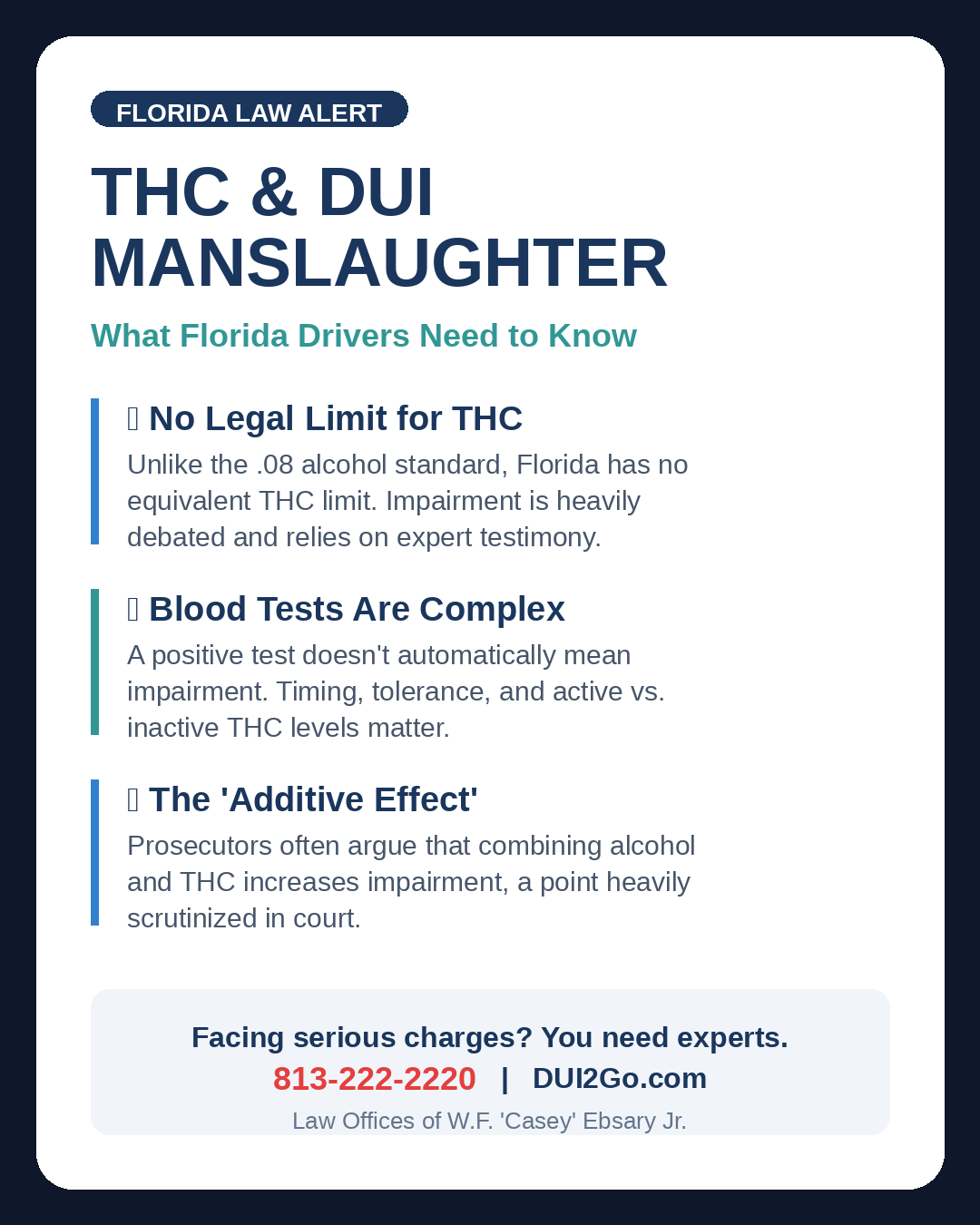
The court also emphasized that no “per se” THC impairment number currently exists in Florida law similar to the .08 alcohol standard.
That distinction is important because alcohol DUI cases and marijuana-related DUI cases are often litigated differently.
Why THC DUI Cases Are So Complex
Unlike alcohol cases, marijuana impairment cases frequently involve competing interpretations of toxicology evidence.
In alcohol-only DUI prosecutions, prosecutors often rely heavily on breath or blood alcohol concentration results. However, THC-related DUI cases can involve significantly more debate concerning:
- Absorption rates
- Frequency of marijuana use
- Tolerance
- Timing of consumption
- Residual THC presence
- Individual physiology
- Laboratory testing methods
The court order itself acknowledged that impairment allegedly depends on multiple variables.
That means these cases often become battles between experts.
Key Differences Between Alcohol and THC DUI Allegations
| Alcohol DUI Cases | THC-Related DUI Cases |
|---|---|
| Florida has a statutory .08 standard | No equivalent THC standard identified in Florida law |
| Breath testing commonly used | Blood testing more common |
| Impairment science more standardized | THC impairment remains heavily debated |
| Jurors often familiar with alcohol impairment | THC impairment may be less understood |
| Toxicology interpretation may be more straightforward | Interpretation may involve greater scientific disagreement |
The Importance of Daubert Challenges in Florida DUI Cases
Florida courts use the Daubert standard to evaluate whether expert testimony is scientifically reliable and relevant before it is presented to a jury.
A Daubert challenge can involve arguments concerning:
- Scientific reliability
- Peer-reviewed research
- Error rates
- Methodology
- Expert qualifications
- Relevance to the issues in the case
In serious felony DUI prosecutions, these hearings may become one of the most important parts of the defense strategy.
The ruling discussed here demonstrates that prosecutors may attempt to use toxicologists to explain:
- Alleged impairment
- Reaction time
- Divided attention issues
- Driving performance
- Combined alcohol and THC effects
A defense attorney may challenge whether the proposed testimony satisfies Florida evidentiary standards.
For information about aggressive DUI defense representation in Florida, visit Florida DUI Defense Lawyer.
DUI Manslaughter Charges in Florida
DUI manslaughter allegations are among the most serious criminal charges prosecuted in Florida courts.
These cases may involve:
- Fatal traffic crashes
- Blood testing
- Accident reconstruction
- Toxicology experts
- Law enforcement crash investigators
- Cell phone evidence
- Vehicle data downloads
- Medical testimony
A conviction can expose a defendant to severe penalties, including substantial prison exposure.
However, every accused person remains presumed innocent unless the State proves guilt beyond a reasonable doubt.
Common Areas of Defense Investigation in Serious DUI Cases
| Defense Investigation Area | Why It Matters |
|---|---|
| Blood draw procedures | Chain of custody and contamination issues |
| Toxicology methodology | Accuracy and interpretation |
| Accident reconstruction | Causation disputes |
| Medical conditions | Alternative explanations |
| Officer observations | Reliability and consistency |
| Video evidence | Contradicting allegations |
| Witness statements | Credibility concerns |
| Timing evidence | Substance absorption disputes |
THC and Alcohol: The “Additive Effect” Issue
One major issue in the ruling involved testimony concerning the alleged “additive effect” between alcohol and Delta-9 THC.
The toxicologist reportedly testified that both substances are central nervous system depressants and may allegedly increase impairment when combined.
The court concluded that this testimony was sufficiently reliable to be heard by a jury.
However, defense attorneys may still challenge:
- The scope of the expert’s conclusions
- Whether the science applies to a specific defendant
- Whether the expert is overstating impairment
- Whether the State can prove actual impairment at the relevant time
These cases often require careful cross-examination and independent expert review.
Why Blood Test Evidence Is Not Always Simple
Many people assume blood testing automatically proves impairment. That is not necessarily true.
Blood evidence can raise numerous questions, including:
- Was the sample properly preserved?
- Was testing properly conducted?
- Was the chain of custody maintained?
- What do the numbers actually mean?
- Can toxicology establish impairment?
- Was the substance active or inactive?
- Could the result reflect prior use rather than current impairment?
The court order discussed measurable Delta-9 THC levels, but also acknowledged there is no universally accepted THC impairment threshold comparable to alcohol standards.
That distinction can become central in litigation.
DUI Manslaughter Litigation Often Requires Multiple Experts
Serious DUI felony cases may involve testimony from:
| Type of Expert | Possible Role |
|---|---|
| Toxicologist | Substance interpretation |
| Accident reconstructionist | Crash causation |
| Pharmacologist | Drug absorption/effects |
| Medical examiner | Cause of death |
| Human factors expert | Driver perception/reaction |
| Forensic laboratory analyst | Testing procedures |
Complex felony DUI cases may require a defense team capable of challenging highly technical scientific evidence.
Attorney W.F. “Casey” Ebsary Jr. is a Board Certified Criminal Trial Lawyer with extensive DUI defense experience. Learn more at Meet Casey Ebsary Jr..
What Makes Florida DUI Cases Different?
Florida DUI prosecutions can involve aggressive investigation techniques and sophisticated forensic evidence.
In some cases, prosecutors may attempt to use:
- Breath test results
- Blood test evidence
- Field sobriety exercises
- Body camera footage
- Surveillance video
- Crash reconstruction analysis
- Toxicology testimony
The legal and scientific issues may overlap extensively.
That is especially true in cases involving allegations of controlled substances.
Timeline of a Typical Serious DUI Case
| Stage | What May Occur |
|---|---|
| Investigation | Law enforcement gathers evidence |
| Arrest | DUI or felony charges filed |
| Discovery | Evidence exchanged |
| Motion practice | Challenges to evidence |
| Expert review | Toxicology and crash analysis |
| Hearings | Daubert and suppression motions |
| Negotiations | Plea discussions |
| Trial | Jury determines guilt or innocence |
10 Frequently Asked Questions About DUI Manslaughter and THC Evidence

In some cases, yes. Courts may allow toxicology evidence involving Delta-9 THC if the judge determines the testimony satisfies Florida evidentiary standards.
I do not know of any Florida statute establishing a specific per se THC impairment level equivalent to the .08 alcohol standard.
A Daubert challenge is a legal challenge to expert testimony. The court evaluates whether the proposed scientific testimony is sufficiently reliable and relevant.
No. The mere presence of a substance does not necessarily resolve whether the prosecution can prove impairment beyond a reasonable doubt.
The court order itself noted multiple factors may affect alleged impairment, including tolerance, dosage, absorption rate, and frequency of use.
In this case, the court allowed testimony concerning the alleged additive effects of alcohol and Delta-9 THC.
Potential defenses can involve toxicology interpretation, causation, accident reconstruction, constitutional issues, witness credibility, and laboratory procedures. Every case is different.
Blood testing can become the subject of litigation concerning collection, preservation, laboratory methodology, contamination, and interpretation.
If expert testimony is excluded, it may significantly affect the prosecution’s ability to present certain scientific evidence at trial.
Serious felony DUI cases often involve fast-moving evidence collection and complex scientific issues. Early legal representation may be important.
The Role of Jury Interpretation
One important aspect of the ruling is the court’s conclusion that the degree of impairment ultimately becomes a jury question.
That means jurors may hear competing testimony from prosecution and defense experts concerning:
- THC levels
- Alcohol interaction
- Reaction time
- Driver behavior
- Toxicology limitations
- Scientific uncertainty
The defense may argue the State failed to establish impairment beyond a reasonable doubt.
Why Early Investigation Matters
In serious DUI cases, evidence can disappear quickly.
Potential evidence may include:
- Surveillance footage
- Vehicle electronic data
- Witness recollections
- Crash scene measurements
- Phone records
- Toxicology documentation
Early investigation can be critical.
If you need legal representation for a DUI or DUI manslaughter investigation in Florida, contact the Law Office of W.F. Casey Ebsary Jr. through DUI2Go Contact Page.
Scientific Evidence Continues to Evolve
One important takeaway from this ruling is that courts continue to confront emerging scientific and legal questions involving marijuana-related DUI allegations.
As marijuana laws and usage patterns evolve nationally, litigation involving:
- Toxicology interpretation
- THC impairment
- Driving behavior
- Expert testimony
- Scientific reliability
will likely continue to expand in Florida courtrooms.
That does not mean every prosecution automatically succeeds.
Each case remains fact-specific.
Choosing the Right DUI Defense Attorney Matters
Not every criminal defense case involves complex scientific litigation.
DUI manslaughter cases involving blood evidence, toxicology experts, and Daubert hearings may require extensive preparation and technical understanding.
When evaluating legal representation, factors may include:
| Consideration | Why It Matters |
|---|---|
| DUI trial experience | Complex evidentiary litigation |
| Board certification | Demonstrated expertise |
| Scientific understanding | Toxicology and forensic evidence |
| Trial readiness | Ability to litigate expert disputes |
| Case preparation | Reviewing technical evidence |
Attorney W.F. “Casey” Ebsary Jr. is Board Certified in Criminal Trial Law and represents individuals facing serious DUI allegations throughout Florida.
Learn more at:
Final Thoughts
This Florida DUI manslaughter ruling demonstrates how modern DUI prosecutions increasingly involve scientific testimony concerning substances beyond alcohol alone. The court allowed the prosecution to introduce expert testimony concerning Delta-9 THC and its alleged interaction with alcohol after determining the testimony satisfied Florida’s Daubert reliability requirements.
At the same time, the ruling also acknowledged important limitations in the science, including the absence of a universally accepted THC impairment threshold comparable to alcohol standards.
For defendants facing serious DUI allegations, these cases may involve highly technical disputes over toxicology, impairment, laboratory methodology, and causation. The prosecution still carries the burden of proving guilt beyond a reasonable doubt.
If you or a loved one is facing a DUI investigation or felony DUI charge in Florida, speaking with an experienced DUI defense attorney immediately may help protect your rights, preserve evidence, and prepare a strategic defense.