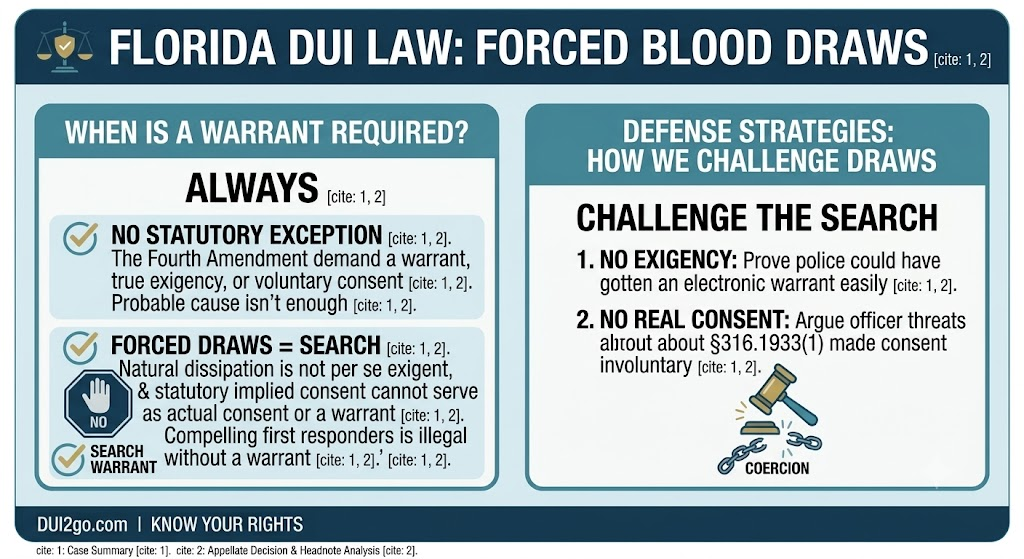
- Free Consultation: 813.222.2220 Tap Here To Call Us




Warrantless DUI Blood Draws in Florida: Why Probable Cause Alone Is Not Enough


In a helpful decision for drivers across the Tampa Bay area and throughout Florida, the Fourth District Court of Appeal in State v. Marlin has struck down the State’s reliance on warrantless, coerced blood extractions following serious DUI crashes. For years, law enforcement officers and prosecutors cited Florida Statutes § 316.1933(1) and isolated dicta from State v. Acevedo to claim that probable cause alone empowered police to force a blood test over a driver’s explicit objection.
The appellate court has firmly slammed that door shut—formally receding from Acevedo and reaffirming that under the Fourth Amendment and Missouri v. McNeely, the natural metabolization of alcohol is not an automatic emergency and officers must secure a judicial search warrant. If law enforcement compelled first responders or hospital staff to draw your blood without a warrant in Tampa, Clearwater, St. Petersburg, or anywhere in Hillsborough or Pinellas County, that evidence may be subject to suppression.
Learn how Board Certified Criminal Trial Lawyer W.F. “Casey” Ebsary Jr. fights unlawful police searches by reviewing our firm credentials and bio. Protect your freedom today by contacting DUI2go.com through our case consultation page or calling (813) 222-2220.

For years following serious traffic crashes, Florida prosecutors have attempted to stretch statutory language to bypass the Fourth Amendment. When a driver refuses a voluntary blood test, law enforcement officers frequently cite Florida Statutes § 316.1933(1) to compel emergency medical personnel or hospital staff to draw blood anyway.
A recurring justification in the State’s playbook stemmed from isolated dicta in State v. Acevedo, 366 So. 3d 1096 (Fla. 4th DCA 2023), where an appellate panel remarked that even without consent, officers had “probable cause to coerce the blood draw.”
In a significant appellate decision, the Florida District Court of Appeal has closed that door, formally receding from the problematic language in Acevedo and reaffirming bedrock constitutional limits on warrantless bodily intrusions.
The Core Holding – DUI Blood Draws in Florida
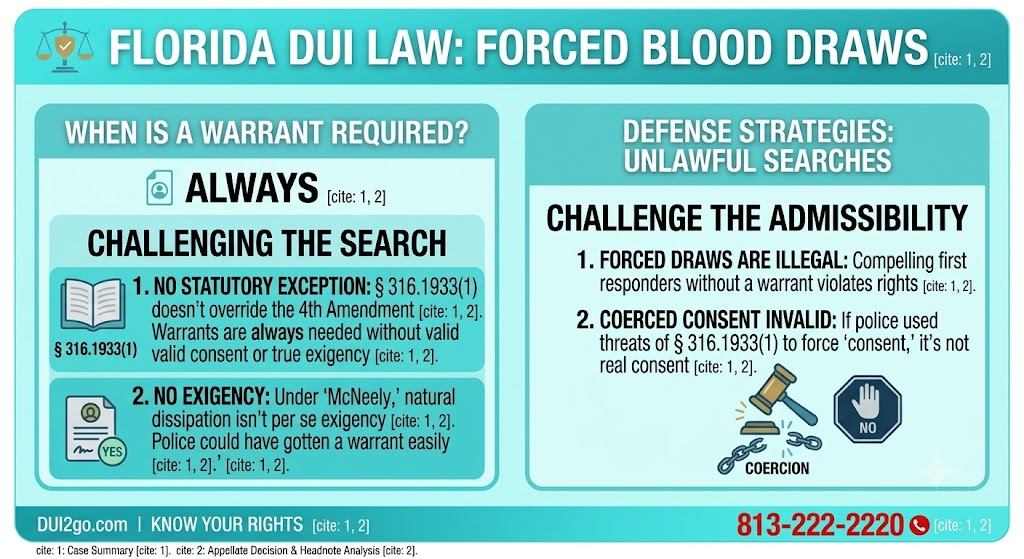
The appellate court affirmed the trial court’s order granting the defendant’s motion to suppress blood draw results as the fruits of an unreasonable search under the Fourth Amendment.
The key takeaways from the ruling include:
- No “Probable Cause” Exception to the Warrant Requirement: Florida Statutes § 316.1933(1) authorizes officers to require blood tests when there is probable cause that an impaired driver caused death or serious bodily injury. However, a state statute cannot dilute constitutional protections. Probable cause alone does not authorize police to invade a person’s bodily integrity without a search warrant.
- Formal Receding from State v. Acevedo: Addressing widespread reliance by prosecutors on Acevedo, the court explicitly receded from any language suggesting that probable cause creates an independent exception allowing police to coerce or compel a blood draw.
- Dissipation Is Not a Per Se Exigent Circumstance: Relying on the United States Supreme Court’s decision in Missouri v. McNeely, 569 U.S. 141 (2013), the court held that the natural metabolic dissipation of alcohol in the bloodstream does not automatically create an emergency. With modern electronic and telephonic warrant procedures widely available across Florida jurisdictions, officers must seek a warrant when feasible.
- Implied Consent Does Not Equal Fourth Amendment Consent: Florida’s implied consent framework carries civil and administrative consequences (such as driver license suspensions), but statutory “implied consent” cannot substitute for voluntary consent or excuse the warrant requirement once a driver explicitly refuses.
Constitutional Law vs. State Statute: What Changed?
| Issue | Erroneous Prosecution Theory | Binding Constitutional Standard |
| Florida Statute § 316.1933(1) | Authorizes forced warrantless blood draws whenever probable cause exists in serious injury/fatal crashes. | Governs statutory authority under state law, but remains subordinate to the Fourth Amendment warrant requirement. |
| Driver Refusal | Refusal can be overridden by directing first responders or nurses to perform a forced extraction. | Once a driver refuses, actual consent is absent; police must obtain a search warrant unless true exigency exists. |
| Exigent Circumstances | Natural metabolization of alcohol over time automatically justifies bypassing a judge. | Under McNeely, dissipation is only one factor; routine investigative delay does not excuse bypassing a warrant. |
Defense Strategy: Challenging Compelled Blood Draws
For individuals facing felony DUI charges in Florida—including DUI Manslaughter and DUI with Serious Bodily Injury—this ruling provides a critical roadmap for defense counsel:
- Scrutinize Warrantless Procedures: If officers commanded medical staff or first responders to draw blood following a refusal without first applying for an electronic search warrant, the blood evidence is subject to suppression.
- Attack Claims of “Exigency”: Prosecutors must prove that officers lacked the time or ability to transmit a warrant affidavit to an on-call duty judge while medical treatment or crash investigations were underway.
- Challenge Coerced “Consent”: In many DUI investigations, officers warn suspects that refusing a draw is futile because “the law allows us to take it anyway.” Misrepresenting statutory authority invalidates voluntary consent as a matter of law.
Appellate Opinion Text & Record Reference
The full slip opinion affirming the suppression order is maintained on the Florida Courts appellate repository at Opinion_2025-1448.pdf.
Appellate Opinion Digest & Case Summary
DISTRICT COURT OF APPEAL OF THE STATE OF FLORIDA
FOURTH DISTRICT
STATE OF FLORIDA,
Appellant,
v.
SEAN MICHAEL MARLIN,
Appellee.
No. 4D2025-1448
[September 2, 2026]
Appeal of a nonfinal order from the Circuit Court for the Seventeenth
Judicial Circuit, Broward County; Thomas Michael Lynch, V, Judge; L.T.
Case No. 062018CF014657A88810.
James Uthmeier, Attorney General, Tallahassee, and Luke R.
Napodano, Senior Assistant Attorney General, West Palm Beach, for
appellant.
William R. Ponall of Ponall Law, Maitland, for appellee.
MAY, J.
Blood draws and DUI charges are at the center of this State appeal from
an order granting the defendant’s motion to suppress. The State argues
the trial court erred in granting the motion to suppress because no state
action occurred in obtaining the blood draw and probable cause supported
the State’s request for a blood draw. We disagree with the State for the
reasons explained below and affirm.
- The Facts
The defendant was driving when his vehicle drifted onto the shoulder
of the Turnpike and struck four motorcycles. The accident resulted in one
fatality and injury to two other people. The State charged the defendant
with two counts of DUI manslaughter (UBAL and impairment), two counts
of DUI with serious bodily injury (UBAL and impairment), one count of DUI
with injury, and five counts of DUI with property damage.
2
The defendant moved to suppress the blood draw results as fruits of an
unreasonable search. The defendant argued law enforcement did not
apply for a search warrant but instead asked the defendant to voluntarily
submit to a blood draw. When the defendant refused, law enforcement
had first responders compel the blood draw.
According to the motion to suppress, law enforcement contacted a state
attorney approximately two hours after the accident and were directed to
apply for a search warrant for the defendant’s blood. Approximately thirty
minutes later, the same state attorney told law enforcement they could
proceed with the blood draw because exigent circumstances existed due
to the elapsed time.
The defendant argued the blood draw was an unconstitutional search
because law enforcement did not obtain a warrant and lacked exigent
circumstances. The defendant argued that “(a) the natural dissipation of
alcohol, alone, does not create a per se exigency; and (b) law enforcement
cannot create its own exigency by failing to take measures to secure a
search warrant for a suspect’s blood.” The defendant requested the trial
court to suppress the blood draw results.
The State responded that law enforcement could order the blood drawn
based on exigent circumstances because the alcohol would dissipate in
the time needed to obtain the search warrant. Alternatively, the State
argued law enforcement could properly order the blood draw, pursuant to
section 316.1933, Florida Statutes (2018), based on State v. Acevedo, 366
So. 3d 1096 (Fla. 4th DCA 2023). In doing so, the State suggested Acevedo
held that section 316.1933 created an exception to the warrant
requirement for nonconsensual blood draws based on the existence of
probable cause. Finally, the State asserted that even if exigent
circumstances did not exist and section 316.1933 did not apply, the
defendant’s blood would have been obtained via inevitable discovery.
- Suppression Hearing & Order
At the hearing on the motion to suppress, the trial court heard from
numerous witnesses to the accident and investigation. Consistent with
his motion, the defendant argued that law enforcement lacked exigent
circumstances to conduct a warrantless, nonconsensual blood draw.
During the discussion, the trial court noted that Acevedo’s “probable
cause” language appeared “very contradictory” to other Florida caselaw
and possibly to the United States Supreme Court’s decision in Missouri v.
3
McNeely, 569 U.S. 141 (2013).1 The defendant characterized the Acevedo
language as “unfortunate dicta.”
In Acevedo, the State charged the defendant with multiple DUI crimes
arising out of a rear-end collision. At the hearing on the motion to
suppress the blood draw, a law enforcement officer testified that a trooper
asked the defendant for consent to draw blood and the defendant
consented. The trooper also testified that he had properly advised the
defendant of his rights under Florida’s implied consent law.
The trial court suppressed the blood draw, concluding the State had
failed to establish the defendant’s voluntary consent. The trial court found
the defendant had not been advised of his “right to refuse and was
misadvised that if he did not agree, law enforcement would get a warrant
and take a blood sample against his will.” Id. at 1099. The State appealed.
On appeal, we found the record “provided sufficient probable cause to
believe” the defendant was under the influence. Id. at 1100. We then
stated that: “even if [the defendant] had not voluntarily consented to the
blood draw, the officer had probable cause to coerce the blood draw.” Id.
We reversed the order suppressing the blood draw.
Here, the State continued to argue that law enforcement had probable
cause for the blood draw, exigent circumstances existed to permit the
warrantless draw, and/or the results would have been inevitably
discovered.
The trial court found no consent had been given, no warrant had been
issued, and no exigent circumstances existed. The trial court also
concluded that inevitable discovery did not apply. Struggling with
Acevedo, the trial court denied the motion to suppress in a written order.
The defendant moved for rehearing and argued the trial court’s decision
and reliance on Acevedo’s “probable cause” language essentially
overturned McNeely. The trial court noted that if the State’s interpretation
of section 316.1933 was correct under Acevedo, the caselaw on consent
1 In McNeely, the Court addressed “whether the natural metabolization of alcohol
in the bloodstream presents a per se exigency that justifies an exception to the
Fourth Amendment’s warrant requirement for nonconsensual blood testing in all
drunk-driving cases.” 569 U.S. at 145. The Supreme Court held natural
metabolization does not present a per se exigency that justifies an exception to
the Fourth Amendment. Exigent circumstances must be decided on a case-by-
case basis based on the totality of the circumstances. Id. at 156.
4
and exigent circumstances would be irrelevant because police could “get
the blood” any time probable cause existed. The State argued that Acevedo
did not expressly find the defendant’s consent voluntary; therefore, the
“probable cause” language must have been a holding rather than dicta.
The trial court then reversed itself and granted the defendant’s motion
for rehearing and his motion to suppress.
From this order, the State now appeals.
- The Analysis
We briefly review the law on blood draws in DUI cases.
I. Blood Draws in DUI Cases
DUI charges are extremely serious because of the potential harm
driving under the influence can inflict on human lives and property. See
Birchfield v. North Dakota, 579 U.S. 438, 443 (2016).2 So too are a
defendant’s constitutional rights extremely serious and zealously guarded.
See McNeely, 569 U.S. at 148. These two competing interests have been
the subject of numerous opinions within and without our jurisdiction.
They once again step into the legal boxing ring to compete.
So, let’s start at the beginning. “The Fourth Amendment provides in
relevant part that ‘[t]he right of the people to be secure in their persons,
houses, papers, and effects, against unreasonable searches and seizures,
shall not be violated, and no Warrants shall issue, but upon probable
cause.’” Id. A motorist ordinarily may not be compelled “to submit to the
taking of a blood sample or to a breath test unless a warrant authorizing
such testing is issued by a magistrate.” Birchfield, 579 U.S. at 454. There
are, however, exceptions.
A. Consent
Courts have consistently held that where actual consent exists, no need
exists to rely on Florida’s implied consent laws or to obtain a warrant.
Robertson v. State, 604 So. 2d 783, 790 (Fla. 1992) (“If the defendant has
consented to the test, or consent is implied on some basis independent of
the DUI laws, then the blood test falls wholly outside the scope of the
2 “Alcohol consumption is a leading cause of traffic fatalities and injuries. During
the past decade, annual fatalities in drunk-driving accidents ranged from 13,582
deaths in 2005 to 9,865 deaths in 2011.” Id. at 465.
5
implied consent law.”); State v. Meyers, 261 So. 3d 573, 574 (Fla. 4th DCA
2018) (“The Florida Supreme Court has explained . . . that if a defendant
expressly consents to a blood test, ‘then the blood test falls wholly outside
the scope of the implied consent law.’” (quoting Robertson, 604 So. 2d at
790)); State v. Liles, 191 So. 3d 484, 487 (Fla. 5th DCA 2016) (“One of the
well-established exceptions to the requirements of both a warrant and
probable cause is a search conducted pursuant to consent.”).
B. Exigent Circumstances
Exigent circumstances is another such exception. But the Court made
clear that “while the natural dissipation of alcohol in the blood may
support a finding of exigency in a specific case, . . . it does not do so
categorically. Whether a warrantless blood test of a drunk-driving suspect
is reasonable must be determined case by case based on the totality of the
circumstances.” McNeely, 569 U.S. at 156.
C. Search Incident to Arrest
Most recently, the Court held that “a breath test, but not a blood test,
may be administered as a search incident to a lawful arrest for drunk
driving.” Birchfield, 579 U.S. at 476. The Court further held “that
motorists cannot be deemed to have consented to submit to a blood test
on pain of committing a criminal offense.” Id. at 477. In doing so, the
Court disavowed that statutory “implied consent” can serve as a substitute
for actual consent or a warrant.
D. Warrant Requirement
These recent decisions lead to but one conclusion. Unless a motorist
gives actual consent or a court determines under the totality of the
circumstances that exigent circumstances exist, a warrant must be
obtained for a blood draw to satisfy the Fourth Amendment. See Liles, 191
So. 3d at 488. This is true regardless of a state’s implied consent laws.
Following McNeely, we must read section 316.1933, Florida
Statutes, as a directive to law enforcement to obtain blood
samples in serious and deadly crashes when probable cause
exists to suggest impaired driving. To comply with McNeely,
the statute must assume the blood draw will be obtained with
a warrant, absent consent or proof of exigent circumstances.
6
Id. at 489.3
E. Implied Consent Laws
In State v. Marshall, 418 So. 3d 647, 650–51 (Fla. 4th DCA 2025), we
reviewed Florida’s implied consent laws. Those laws provide statutory
authority for breath, urine, and blood testing under specified
circumstances and provide administrative penalties for a motorist’s refusal
to comply. See §§ 316.1932–.1933, Fla. Stat. (2024). Those laws, however,
are subject to the constitutional safeguards outlined above and addressed
by the United States Supreme Court in McNeely and Birchfield.
II. The Present Case
Here, the State argues the trial court erred in granting the motion to
suppress because section 316.1933(1), Florida Statutes (2018), provided
the consent necessary to satisfy the Fourth Amendment. The State further
argues that section 316.1933(1) is not contrary to McNeely or any other
United States Supreme Court decision. The State suggests the trial court’s
ruling is contrary to Acevedo, which the State claims held that a blood
draw can be coerced when law enforcement has probable cause.4
The defendant responds that the trial court correctly granted the
motion to suppress. We agree.
“A trial court’s ruling on a motion to suppress comes to the appellate
court with a presumption of correctness and [we] must interpret the
evidence and reasonable inferences and deductions derived therefrom in a
manner most favorable to sustaining the trial court’s ruling.” R.F. v. State,
307 So. 3d 20, 22 (Fla. 4th DCA 2020) (citations omitted). We apply “a de
novo standard of review to the mixed questions of law and fact that
ultimately determine constitutional issues.” Id.
As we previously noted, the Fourth Amendment prohibits
“unreasonable searches” and applies to a blood draw. Birchfield, 579 U.S.
at 455. “To comply with the Fourth Amendment, law enforcement officers
3 We recognize that section 933.02 does not authorize search warrants for
misdemeanor DUIs.
4 On appeal, the State has abandoned its exigent circumstances and inevitable
discovery arguments made to the trial court, thus waiving those arguments. See
Hammond v. State, 34 So. 3d 58, 59 (Fla. 4th DCA 2010).
7
must obtain a warrant or consent for a blood draw, or there must be some
other exception to the warrant requirement.” Liles, 191 So. 3d at 486.
In Liles, the Fifth District rejected the State’s similar argument that the
parties’ statutory “implied consent” satisfied the Fourth Amendment. Id.
at 488. The Fifth District concluded that because the defendants did not
consent to the blood draw, “the warrantless blood searches were not
authorized by the consent exception.” Id.
The State acknowledges that its argument here runs afoul of Liles but
suggests we should decline to follow Liles. But we have previously agreed
with Liles. See McGraw v. State, 245 So. 3d 760, 769 (Fla. 4th DCA 2018).
There, we stated, “that when a defendant specifically withdraws his or her
consent, the state cannot compel a blood draw.” Id. We also advised, “the
State would not be able to rely on implied consent as an exception to the
warrant requirement.” Id.5
The State next argues that Acevedo created a “probable cause”
exception to the warrant requirement for blood draws.6 We disagree.
First, the U.S. Supreme Court has instructed us that a warrant is
required to obtain a blood draw unless exigent circumstances or actual
consent exists. Birchfield, 579 U.S. at 474 (“Blood tests are significantly
more intrusive, and their reasonableness must be judged in light of the
availability of the less invasive alternative of a breath test. Respondents
have offered no satisfactory justification for demanding the more intrusive
alternative without a warrant.”). Second, nothing in Acevedo articulated
such an exception. One thing is apparent, however: Acevedo’s language
has created confusion that needs clarification.
III. Clarifying Acevedo
In Acevedo, we stated that “even if [the defendant] had not voluntarily
consented to the blood draw, the officer had probable cause to coerce the
blood draw.” Acevedo, 366 So. 3d at 1100. Taking the sentence as worded,
5 The Florida Supreme Court subsequently vacated McGraw and remanded the
case for further proceedings consistent with Mitchell v. Wisconsin, 588 U.S. 840
(2019). McGraw v. State, 289 So. 3d 836, 839 (Fla. 2019).
6 The State argued Acevedo’s probable cause language was a holding rather than
dicta as evidenced by the defendant’s attempt to seek conflict jurisdiction in the
Florida Supreme Court. The State suggests that Acevedo “change[d] things”
concerning section 316.1933.
8
the first clause, by negative implication, reflects our decision that the
record supported the defendant’s actual consent to the blood draw.
It is the second clause, unnecessary to our decision and thus non-
binding dicta, that has created confusion.7 The State has taken Acevedo’s
language and run with it as a new exception to the Birchfield warrant
requirement to obtain a blood draw. We simply do not have the authority
to create an exception contrary to United States Supreme Court authority.
And Acevedo neither intended nor articulated a probable cause exception
by the language employed. To the extent the clause suggests otherwise,
we recede from that language.
For the foregoing reasons, we affirm the order suppressing the blood
draw in this case as it occurred without a warrant and without exigent
circumstances.
Affirmed.
SHEPHERD and LOTT, JJ., concur.
SHEPHERD, J., concurs specially with opinion.
SHEPHERD, J., concurring specially.
I concur with the majority opinion. I write simply to call attention to
two other opinions where we have either conflated the lines between actual
and statutory implied consent or misstated details of our DUI law. See,
e.g., Chu v. State, 521 So. 2d 330 (Fla. 4th DCA 1988), and State v.
Marshall, 418 So. 3d 647 (Fla. 4th DCA 2025).
Consent is an exception to a warrant requirement and to Florida’s
implied consent law. “The Florida Supreme Court has explained, however,
that if a defendant expressly consents to a blood test, ‘then the blood test
falls wholly outside the scope of the implied consent law.’” State v. Meyers,
261 So. 3d 573, 574 (Fla. 4th DCA 2018) (citing Robertson v. State, 604
So. 2d 783, 790 (Fla. 1992) (cleaned up)).
7 See Myrick v. State, 427 So. 3d 1, 12 (Fla. 4th DCA 2025) (Harper, Assoc. J.,
concurring in part) (“Because that dismissal was unnecessary to the Court’s
holding, it constitutes dicta rather than binding precedent.”) (emphasis added);
United States v. Kaley, 579 F.3d 1246, 1253 n.10 (11th Cir. 2009) (explaining
dictum is “a statement in a judicial opinion that could have been deleted without
seriously impairing the analytical foundations of the holding”) (quoting United
States v. Crawley, 837 F.2d 291, 292 (7th Cir. 1988)); see also Cohens v. Virginia,
19 U.S. 264, 399 (1821) (stating “general expressions” not necessary to the
decision “ought not to control the judgment in a subsequent suit”).
9
Implied consent is codified in chapter 316, Florida Statutes (2024),
specifically sections 316.1932, .1933, and .1934. Florida’s implied
consent law, “essentially require[s] all persons accepting a license to drive
in Florida to consent to a blood-alcohol test upon being arrested for driving
under the influence.” Montes–Valeton v. State, 216 So. 3d 475, 481 n.1
(Fla. 2017) (quotation omitted).
Chu predates the more recent United States Supreme Court decisions
on blood draws, Missouri v. McNeely, 569 U.S. 141 (2013), and Birchfield
v. North Dakota, 579 U.S. 438, 443 (2016). The Florida Supreme Court in
Robertson v. State, 604 So. 2d 783, 790 (Fla. 1992), determined that “if the
defendant has consented to the test, or consent is implied on some basis
independent of the DUI laws, then the blood test falls wholly outside the
scope of the implied consent law.” Indeed, Robertson explained that the
implied consent law and its exclusionary rule apply only when blood is
taken pursuant to the statutory implied consent framework. Id. at 790
n.7.
In Chu, we held that law enforcement’s failure to advise the suspected
impaired driver of the consequences of refusing to consent to a breath or
urine test under Florida’s implied consent law was irrelevant where the
defendant had voluntarily consented to the blood draw. 521 So. 2d at 332.
This is consistent with the existing law and the majority opinion. Consent
is also an exception to the warrant requirement for a blood draw.
However, in Chu, we also suggested that consent meant the law
enforcement officer had “fully informed [the individual] that the implied
consent law required submission only to a breath or urine test and that
the blood draw was an alternative.” Id. at 332. In doing so, we blurred
consent with implied consent. It is unnecessary to advise a motorist of the
implied consent law where the driver provides actual and voluntary
consent. The two concepts provide distinct bases for obtaining a chemical
test, and the requirements attendant to one should not be imported to the
other. Law enforcement’s requirement to inform a motorist of the implied
consent law only comes into play when law enforcement seeks to rely upon
the statutory implied consent framework rather than a motorist’s actual
consent.
And in Marshall, we correctly quashed an order suppressing a blood
draw because we were “unable to discern the trial court’s rationale for
granting the motion.” Id. at 652. However, in discussing the various
implied consent laws, we stated that subsection 316.1932(1)(c) applied
when blood was drawn at a hospital or medical facility but not when the
10
blood draw occurred in a fire rescue ambulance parked at the accident
scene or en route to a hospital. But we failed to recognize that section
316.1932(1)(c) defines “other medical facility” to include “an ambulance or
other medical emergency vehicle.” § 316.1932(1)(c), Fla. Stat. (2024).
Thus, the statutory text itself identifies ambulances and medical
emergency vehicles as permissible locations for a DUI blood draw.
In Marshall, we also stated that “[s]ection 316.1932(1)(a) applies when
the blood test is ‘incidental’ to a lawful arrest and conducted ‘at the request
of a law enforcement officer who has reasonable cause to believe [the
individual] was driving or was in actual physical control of a motor vehicle
while under the influence’ of alcoholic beverages.” Marshall 418 So. 3d at
- However, section 316.1932(1)(a) actually states, “[t]he chemical or
physical breath test must be incidental to a lawful arrest and administered
at the request of a law enforcement officer who has reasonable cause to
believe such person was driving or was in actual physical control of the
motor vehicle within this state while under the influence of alcoholic
beverages.” § 316.1932, Fla. Stat. (2024) (emphasis added).
Our subsequent cases have shifted from any broad reading of Chu, but
we have not had the opportunity to revisit and vacate Chu’s language that
requires an officer to read the implied consent law to obtain actual
consent. In State v. Dubiel, 958 So. 2d 486 (Fla. 4th DCA 2007), we
distinguished Chu and reversed an order suppressing blood test results
where the defendant had consented to a blood draw performed at a
hospital, even though law enforcement had not advised him of the
consequences of refusal to consent. Likewise, in State v. Meyers, 261 So.
3d 573 (Fla. 4th DCA 2018), without discussing Chu, we held that a blood
draw administered in a hospital was admissible when the defendant had
consented to the blood draw without being advised of implied consent.
And in Department of Highway Safety & Motor Vehicles v. Davis, 264 So.
3d 965 (Fla. 4th DCA 2019), we further distinguished Chu by holding that
Dubiel, rather than Chu, controlled where the defendant was in the
hospital and voluntarily consented to the blood draw, and by reiterating
that, under those circumstances, the implied consent law did not apply
and the officer therefore was not required to satisfy its statutory
prerequisites.
Thus, Dubiel, Meyers, and Davis have progressively narrowed Chu’s
practical reach. And our sister court has gone further still. In State v.
Murray, 51 So. 3d 593 (Fla. 5th DCA 2011), the court expressly observed
that Chu “likely sweeps too broadly” and stated that, to the extent Chu
requires implied-consent warnings despite a defendant’s actual voluntary
consent, Murray was in “direct and express conflict” with Chu. Id. at 596.
11
Taken together, these cases underscore two related points. First,
consent and statutory implied consent are distinct concepts, and the
requirements of the implied consent law should not be imported into a
blood draw supported by a motorist’s voluntary consent. Consent can be
given by a motorist at any time, in any location, including in a setting
bereft of reasonable suspicion or probable cause if it is voluntary. Second,
when the implied consent statute does apply, the mere happenstance of
the defendant’s location is not determinative of whether breath, urine, or
blood is authorized. A blood draw in a hospital without consent must still
satisfy either the warrant requirement or the impractical/impossible prong
to qualify as legislatively authorized, pursuant to implied consent. If
consent is voluntarily given, location is irrelevant.
Alas, this case does not involve the problems raised by language in Chu
and Marshall, so those cases remain outside the reach of our majority
opinion. We shall have to wait another day to address these issues when
properly presented to us.
Not final until disposition of timely-filed motion for rehearing