- Free Consultation: 813.222.2220 Tap Here To Call Us




Can You Get a DUI on Private Property in Florida?


One of the most persistent legal myths circulating among drivers is the idea of a “safe zone.” Many people believe that as long as they are driving on private developments, gated residential communities, commercial shopping parking lots, or even their own personal driveways, they are completely immune to traffic enforcement and driving under the influence arrests. Let’s clear up this dangerous misconception immediately: Under Florida law, you can absolutely be arrested, charged, and convicted of a DUI on private property.
If law enforcement officers respond to a 911 call, a domestic disturbance, an active security report, or an emergency traffic accident, they have full legal authority to initiate a criminal driving under the influence investigation, even if your vehicle never touched a public highway.
Understanding the Scope of Florida’s DUI Statute
To understand why private land offers zero protection from a criminal charge, you have to look closely at how Florida Statute § 316.193 is explicitly written. Unlike traffic infractions like speeding, failure to signal, or driving with an expired registration—which generally require you to be operating on a “highway” or a publicly maintained roadway—the core driving under the influence statute uses much broader legal language. The law states that a person is guilty of a DUI if they are driving or are in actual physical control of a vehicle within this state while impaired by alcohol or chemical substances.
The phrase “within this state” means exactly what it says. It applies to every square inch inside the geographic borders of Florida, regardless of who owns the asphalt beneath the tires. Courts have consistently ruled that the public safety hazard of an impaired driver exists whether that driver is on an open interstate or moving through a crowded condominium parking structure.
Common Private Property Scenarios Where Arrests Occur
DUI investigations on private land typically don’t begin with a standard police cruiser running radar. Instead, they are almost always triggered by specific, real-world events that bring officers directly to the scene:
Commercial Parking Lots: Shopping centers, grocery stores, and bar parking lots are frequent sites for arrests. Typically, a security guard or an observant bystander calls 911 to report a driver hitting a curb, striking a parked car, or passing out behind the wheel with the engine running.
Gated Communities and Condominiums: Many residents assume that because their neighborhood features private roads maintained by a Homeowners Association (HOA), police cannot enforce laws there. However, if an HOA security officer calls local police to report erratic driving, or if a resident calls about a vehicle blocking a driveway, responding officers have every right to conduct a field sobriety investigation.
Personal Driveways: It is a common scenario: a driver makes it all the way home, pulls into their own driveway, and thinks they are safe. However, if a police officer observed an erratic driving pattern or a traffic violation on a public road, they can follow that vehicle directly onto personal property to complete the traffic stop and initiate an arrest.
Actual Physical Control: Remember, you do not even have to be actively moving to get a DUI. If you are sitting in the driver’s seat of a parked car on private property with the keys in your possession—even if you are just “sleeping it off” with the air conditioning running—Florida law considers you to be in actual physical control of the vehicle, which is legally sufficient for an arrest.
Video Transcript Summary
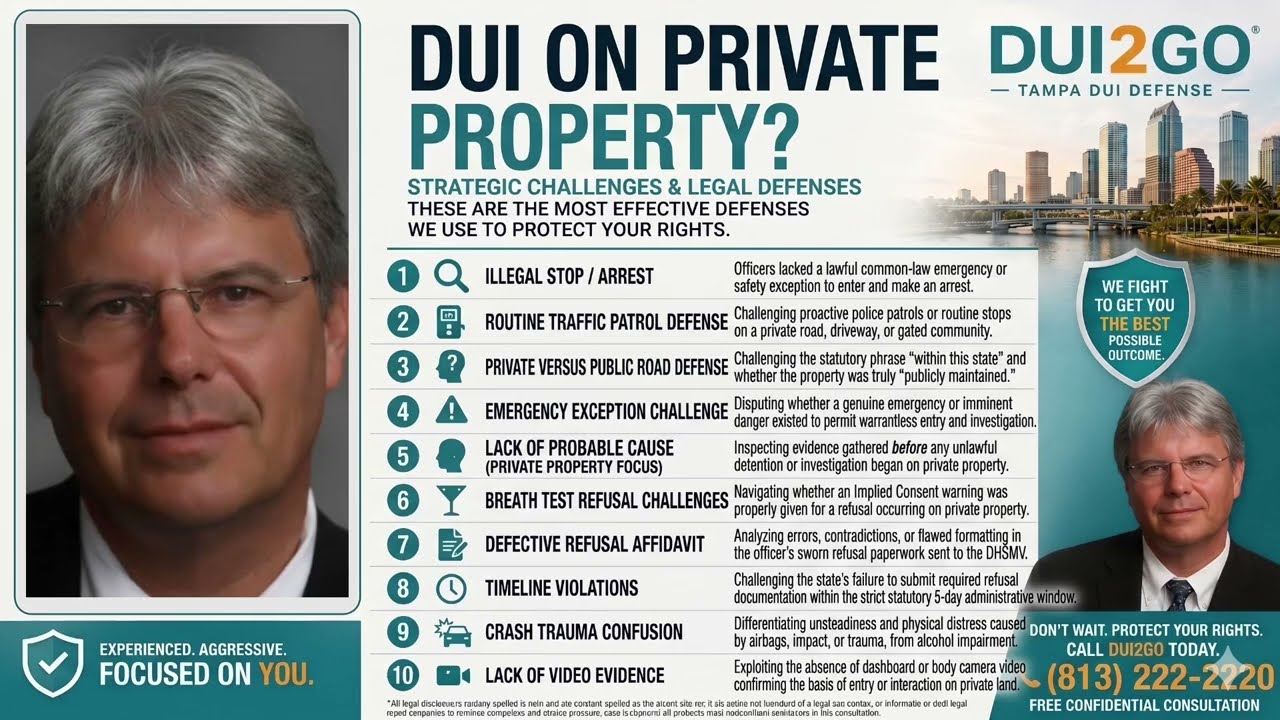
Board-Certified criminal defense attorney Casey Ebsary addresses the common misconception that drivers are legally protected from traffic enforcement while on private property. The legal overview explains that in the state of Florida, a DUI can happen anywhere. If law enforcement officers respond to a 911 emergency call or an active accident scene, a criminal driving under the influence investigation can lawfully take place on private developments, parking lots, or driveways.
Fierce DUI Defense in Hillsborough and Pinellas Counties
If you were arrested on private property, the specific details of how law enforcement arrived at your vehicle are absolutely critical to your defense. Did the police have a legal right to enter the property? Did they have reasonable suspicion to detain you, or did they act on an anonymous, unverified tip? These are highly technical constitutional questions that can make or break the prosecution’s case.
As a Board-Certified Criminal Trial Specialist and former prosecutor with more than 30 years of courtroom experience, W.F. “Casey” Ebsary Jr. systematically audits the state’s evidence to uncover constitutional violations, challenge illegal property entries, and aggressively protect your freedom.
Learn more About My Background
Read our comprehensive article on Handling DUI Charges on Private Property in Tampa
Call Casey at 813-222-2220
You can review our complete analysis of private property jurisdictions and traffic stops by watching our short video.

DUI Expert