- Free Consultation: 813.222.2220 Tap Here To Call Us




Arrested for a DUI Under .08 in Florida? Impairment Trap


Yes. One of the most persistent and dangerous misconceptions about traffic laws is that you are completely safe from a driving under the influence conviction as long as your blood-alcohol concentration (BAC) or breath-alcohol level remains below a 0.08.
Many drivers assume that 0.08 is a mandatory starting line for an arrest. However, under Florida law, this is simply not true. You can be pulled over, placed in handcuffs, and fully convicted of a DUI even if your chemical test results come back well below the statutory limit.
To understand how this happens, you have to look at the exact legal definition of driving under the influence in Florida, which allows the prosecution to prove its case in two completely distinct ways.
The Two Tracks to a Florida DUI Conviction
Under Florida Statute § 316.193, the state does not need a chemical test number to secure a conviction. The law establishes that a person is guilty of driving under the influence if they are operating a vehicle and are affected by alcohol, chemical substances, or controlled substances to a specific degree. The prosecution can prove this state of unlawful operation by matching your behavior to either of these two legal tracks:
The “Per Se” Legal Limit Track: This is the standard numerical threshold. If the state proves your blood-alcohol or breath-alcohol level was 0.08 percent or higher at the time of operation, you are legally presumed impaired. The prosecutor does not need to show that you were driving erratically or slurring your words—the number itself completes the charge.
The “Impairment of Normal Faculties” Track: This is where drivers under a 0.08 get caught in the legal trap. The law states that you are guilty of a DUI if your normal faculties are impaired by alcohol or drugs. Normal faculties include your ability to see, walk, talk, judge distances, react in emergencies, and perform basic driving maneuvers safely.
If a law enforcement officer observes driving patterns like weaving across lanes, failing to maintain speed, or reacting slowly to traffic signals, they have the legal authority to initiate a traffic stop. If they then note the odor of alcohol, glassy eyes, or unsteady balance during roadside exercises, they can arrest you based solely on their subjective observations of your physical impairment—regardless of what a breathalyzer says later.
If you submit to a breath test at the police station and the results register between a 0.05 and a 0.08, Florida law does not automatically dismiss your case. Instead, under Florida Statute § 316.1934, a result in this middle zone carries no legal presumption either way. The state cannot automatically claim you were drunk based on the number, but your defense cannot claim you were automatically sober either. In this situation, the prosecutor will lean heavily on alternative evidence to convince a jury that your normal faculties were compromised:
Subjective Officer Testimony: The arresting officer’s description of your demeanor, speech, and cooperative attitude.
Roadside Field Sobriety Exercises: Your performance on coordination tests like the One-Leg Stand, the Walk-and-Turn, and the Horizontal Gaze Nystagmus (eye tracking test).
Dashboard and Bodycam Videos: High-definition video recordings documenting your physical movements and reactions from the initial traffic stop through the arrest processing.
Furthermore, if you blow a 0.00 or a negligible alcohol level but continue to exhibit physical signs of instability, the police will immediately suspect drug-induced impairment and request a urine or blood sample to screen for prescription medications, over-the-counter drugs, or controlled substances.
Video Transcript Summary
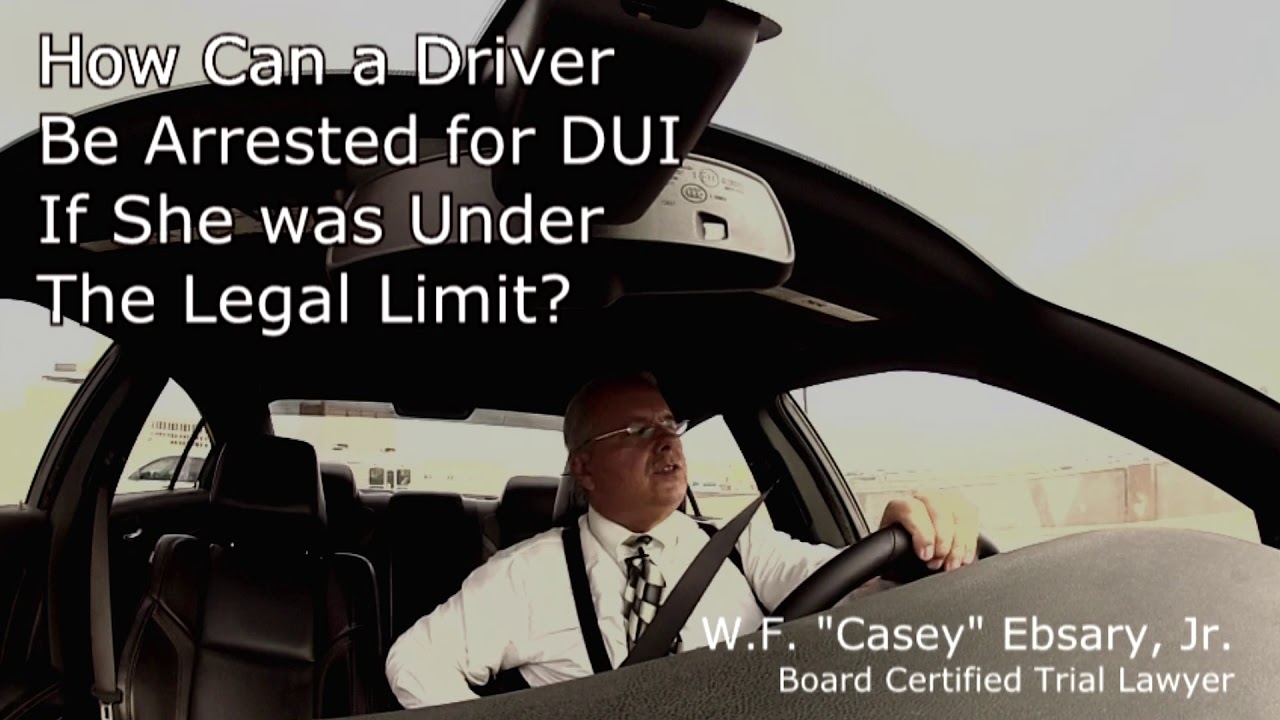
Florida defense attorney Casey Ebsary explains that a driver can absolutely be arrested and convicted of a DUI in Florida even if their breath or blood test results are below the 0.08 legal limit
[00:03]. The guide breaks down the two distinct methods prosecutors use to prove driving under the influence: establishing a chemical test result over a 0.08 [00:26
] or demonstrating through law enforcement observations that the driver’s normal faculties were physically impaired [00:16].
Defending an “Impairment Only” Case in Tampa Bay
When the state’s case lacks a high breathalyzer reading, the prosecution’s entire argument rests on subjective opinions and police interpretations of roadside performance. These cases are highly contestable. Physical conditions, medical issues, nervous exhaustion, and poorly maintained roadside environments can all make a perfectly sober driver look impaired on a police video.
As a Board-Certified Criminal Trial Specialist and former prosecutor, W.F. “Casey” Ebsary Jr. knows how to challenge subjective police narratives, audit the training records of arresting officers, and present a clear defense designed to protect your driving record and your future.
Learn more About Our Firm’s Trial Background
Contact Our Tampa Office Immediately to schedule a case review and evaluate your legal options.
Call Casey at 813-222-2220