- Free Consultation: 813.222.2220 Tap Here To Call Us




Tampa School Zone Speed Camera Map Tickets


Tampa School Zone Speed Camera Tickets: How I Challenge Florida Automated Speeding Citations
If you received a school zone speed camera ticket in Tampa, Hillsborough County, Pinellas County, or anywhere in Florida, do not assume that the photograph on the Notice of Violation means the case is over.
Florida law permits certain automated speed detection systems to be used in designated school zones. But when I evaluate one of these cases, I do not stop at the photograph. I want to know where the camera was located, when it was operating, what speed it recorded, what equipment produced the evidence, whether the required records exist, how the government intends to prove ownership, and whether the evidence can be admitted in court.
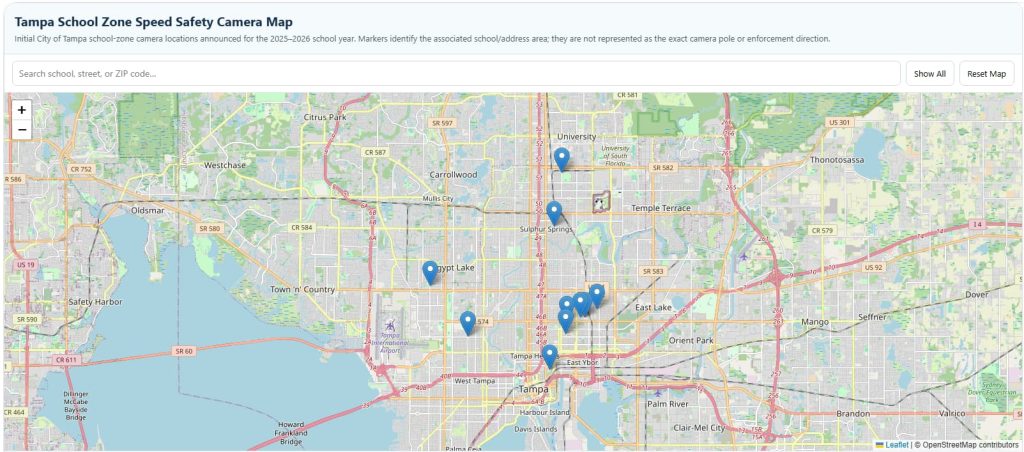
Tampa and Hillsborough County School Zone Camera Locations Map
That distinction became particularly important following two 2026 Florida trial-level decisions involving school-zone speed detection systems: State v. Cardoza in Broward County and State v. Lesmay Gonzalez Rives in Lee County.
The Cardoza order addressed whether the government could use speed evidence from a school-zone speed detection system without establishing the required device approval. The court concluded that the approval requirement remained applicable and dismissed the case when the State could not establish approval.
The Rives order addressed a different evidentiary problem: how the municipality attempted to prove the identity of the registered vehicle owner. The court sustained a hearsay objection to testimony concerning information obtained from the DAVID database and entered a judgment of acquittal after the municipality failed to introduce a certified vehicle registration.
I do not consider either county-court order a statewide binding rule. Instead, I view them as important decisions that demonstrate why I examine the government’s evidence before advising a client whether to contest an automated speeding citation.
Florida School Zone Speed Camera Law
Florida Statutes § 316.1896 establishes the statutory framework for school-zone speed detection system enforcement.
The statute permits a county or municipality to authorize traffic infraction enforcement officers to issue uniform traffic citations for specified violations of Florida’s school-zone and general speeding laws when the violation is evidenced by an authorized speed detection system.
The statute is specific about when automated enforcement can be used. For example, § 316.1896 addresses certain violations occurring more than 10 miles per hour over the applicable school-zone speed limit around the beginning or end of regularly scheduled school sessions and certain violations occurring during a regularly scheduled school session. That means I want to examine more than the number printed on the ticket.
What I Want to Know About the Camera
| Question | Why I Care |
| Where was the camera located? | The location can be important to the statutory and enforcement analysis. |
| What school zone was involved? | I want to identify the applicable zone and speed limit. |
| What time did the alleged violation occur? | The statutory enforcement periods matter. |
| What speed did the system record? | I need to examine the actual allegation. |
| What equipment generated the speed reading? | Device identification can become an evidentiary issue. |
| What testing records exist? | Florida law establishes testing and calibration requirements. |
| What approval documentation exists? | This issue was central to Cardoza. |
| How is ownership being proved? | This issue was central to Rives. |
| What image or video exists? | I want to know exactly what evidence the government possesses. |
| What happened after the Notice of Violation? | Procedural history can affect the available defenses. |
One of the most useful features I would add to this page is an interactive school-zone speed-camera map.
Florida law requires counties and municipalities operating speed detection systems to report information concerning the location of each system, including geographic coordinates, directional approach, school name, school level, operating times, applicable speed limits, and activation or deactivation dates.
Coming Soon Interactive Tampa School Zone Speed Camera Map
[INTERACTIVE MAP EMBED – INSERT YOUR TAMPA/HILLSBOROUGH CAMERA MAP HERE]
Recommended map filters:
| Map Filter | Purpose |
| School | Identify the associated school |
| Camera location | Show the enforcement location |
| Direction | Show the monitored approach |
| Speed limit | Display the applicable posted limit |
| Operating hours | Display reported enforcement times |
| Activation date | Show when the system began operating |
| Deactivation date | Identify systems no longer active |
I would make the map searchable by Tampa, Brandon, Riverview, Temple Terrace, Plant City, and other Hillsborough County communities rather than forcing visitors to search through a long list of camera locations.
What Happened in State v. Cardoza?
The 2026 State v. Rafael D. Cardoza order came from the Broward County Court.
According to the order, the vehicle was recorded traveling 42 miles per hour in a 30-mph school zone in Hollywood. The defense challenged the admissibility of the speed evidence because the speed detection system had not been shown to be approved by the Florida Department of Highway Safety and Motor Vehicles.
The City argued that § 316.1906(3) exempted school-zone speed detection systems from the approval requirement because the statute establishes different testing requirements for those systems.
The court rejected that interpretation.
Design Requirements Are Not Necessarily Device Approval
Florida Statutes § 316.1906(3) provides specific requirements for school-zone speed detection systems, including the ability to perform self-tests, self-testing at least every 30 days, maintenance of self-test logs, and an independent calibration test at least every 12 months.
The Cardoza court distinguished those requirements from the separate approval requirement contained in Florida Administrative Code Rule 15B-2.007(1).
The Florida Department of State’s current administrative-rule listing identifies Rule 15B-2.007 as “Approval Requirements” within Chapter 15B-2, “Speed Measuring Devices.”
According to the Cardoza order, the Legislature had exempted school-zone speed detection systems from particular design criteria but had not expressly exempted them from the approval requirement.
The court therefore concluded that the speed evidence could not be used without the required approval and granted the defense motion.
The Cardoza School Zone Camera Defense Theory
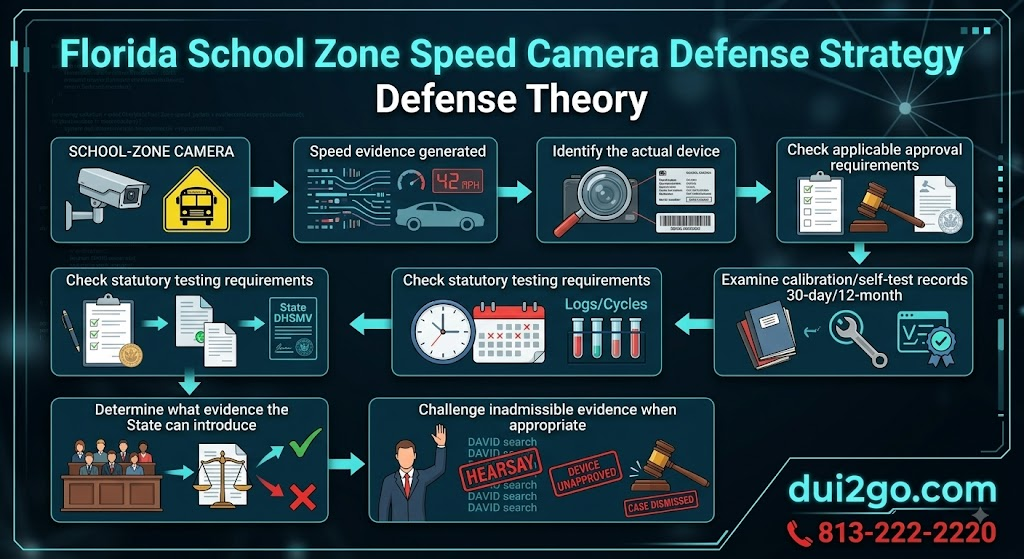
I want to emphasize something important. I would not tell every client with a Florida camera ticket that the ticket must be dismissed because of Cardoza. That would go beyond what this trial-level order establishes. Instead, I would ask whether the facts and evidence in the particular case present the same or a similar issue.
What Does Florida’s Administrative Rule Say?
Florida Administrative Code Chapter 15B-2 is titled Speed Measuring Devices. The Department of State’s current rule listing identifies Rule 15B-2.007 as Approval Requirements and Rule 15B-2.013 as Approved Speed Measuring Devices.
This is why I want to identify the actual system used in a camera case.
A defense investigation should not simply ask:
“Was there a camera?”
I want to ask:
“What exact speed-measuring system produced the evidence, and what documentation establishes that the system satisfies the requirements applicable to its use in court?”
That is a much more useful question.
What Happened in State v. Rives?
The second 2026 order involves State v. Lesmay Gonzalez Rives, Lee County Court Case No. 25-TR-061175.
The supplied order states that Cape Coral used a school-zone speed detection system operated under contract by RedSpeed Florida, LLC. After the system captured the vehicle and license plate, the police sergeant entered the plate information into the state’s DAVID database to determine the registered owner.
Defense counsel objected to the officer’s testimony concerning the registered owner’s identity.
The court sustained the objection.
According to the order, the court found that the testimony concerning the registered owner’s identity constituted hearsay and that no certified copy of the vehicle registration had been introduced. The court therefore entered a judgment of acquittal.
The order also discusses Kahn v. State, Holborough v. State, and Riggins v. State in analyzing the hearsay issue.
The source material states that a notice of appeal was filed June 5, 2026. I have not verified a later appellate disposition, so I will not speculate about what happened after that filing.
Why Florida Hearsay Law Matters
Florida Statutes § 90.801 defines hearsay as a statement made outside the trial or hearing that is offered to prove the truth of the matter asserted, subject to the statutory definitions and exceptions.
That can become important when an officer attempts to prove a fact by repeating information obtained from a computer system, database, document, or another source.
I do not treat every computer record as automatically inadmissible.
Instead, I ask:
- What exactly is the evidence?
- Who created it?
- Who is offering it?
- Why is it being offered?
- What foundation has been established?
- Does a hearsay exception apply?
- Is the government offering a certified record or simply testimony about what a database displayed?
Those questions can make the difference between evidence that can be considered and evidence that cannot.
Florida School Zone Camera Evidence Checklist
When I evaluate one of these cases, I want to build the evidence chain from beginning to end.
| Evidence | Question I Ask |
| Photograph | What exactly does the photograph establish? |
| Speed reading | How was the speed measured? |
| Camera system | What specific device was used? |
| Device approval | What documentation establishes approval? |
| Self-test records | Are required records available? |
| Calibration records | Was the required independent calibration performed? |
| Location data | Where was the camera operating? |
| Operating time | Was the system operating during the relevant statutory period? |
| Vehicle registration | How will ownership be established? |
| Officer testimony | What does the officer personally know? |
| Database evidence | What source is being used and for what purpose? |
| Notice of Violation | Was the statutory procedure followed? |
| UTC | What allegations and evidence are contained in the formal citation? |
A Camera Photograph Is Not the Entire Case
One of the biggest misconceptions I see with automated enforcement is the belief that the photograph is the case. It is not necessarily the entire case.
The photograph may show a vehicle. It may show a license plate. The system may report a speed. But the government may still need to establish other facts through admissible evidence. That is why I examine the entire evidentiary chain.
My Approach
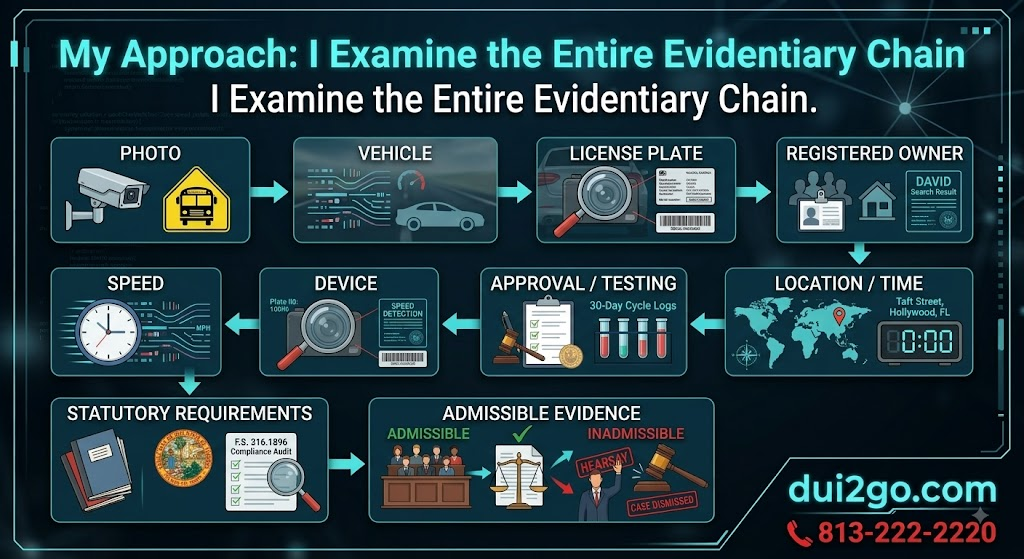
If one part of that chain presents a legally significant problem, I want to know about it before advising my client to simply pay the citation.
Coming Soon Video: Can a Florida School Zone Camera Ticket Be Challenged?
[VIDEO EMBED VIDEO HERE]
Six-Second Video Script
“Got a Florida school-zone camera ticket? Before paying, I want to examine the camera, evidence, and legal requirements.”
Video Title
Florida School Zone Speed Camera Tickets: What I Check Before You Pay
Video Description
I explain what I look for when reviewing a Florida school-zone speed camera ticket, including the speed detection system, applicable testing and approval requirements, ownership evidence, and the admissibility of the government’s evidence.
This video is informational and does not create an attorney-client relationship.
Frequently Asked Questions About Florida School Zone Camera Tickets
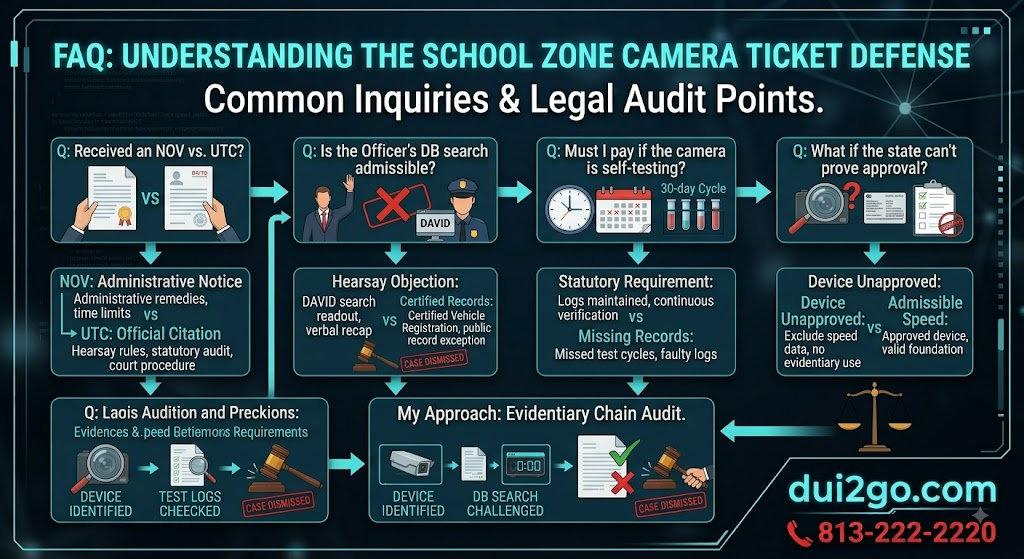
Florida law authorizes specified speed detection systems for certain school-zone speeding violations. Section 316.1896 establishes the circumstances and procedures governing this form of enforcement.
The 2026 Cardoza order provides an example in which the court excluded speed evidence after the State failed to establish the required device approval and dismissed the case. But I would not describe Cardoza as a statewide rule requiring dismissal of every camera ticket.
The statute specifically establishes different requirements for school-zone speed detection systems, including self-testing and annual independent calibration. The Cardoza court concluded that those provisions did not eliminate the separate approval requirement it found applicable under Rule 15B-2.007(1).
I want to examine the citation, Notice of Violation, photographs or video, device information, available testing and calibration records, applicable location information, and the evidence the government intends to use to establish ownership and the alleged speed.
That question has to be evaluated under the Florida Evidence Code and the facts of the particular case. In Rives, the court found the officer’s testimony concerning the registered owner to be hearsay and sustained the defense objection.
Do not ignore the notice. Florida’s school-zone speed detection statute establishes specific procedures and deadlines, and the consequences can depend upon what action is taken after the notice. I recommend reviewing the actual notice rather than relying on a general internet description.
I would not make that decision without first understanding the citation, the available procedures, and the evidence involved. Paying may resolve the matter, while contesting it creates an opportunity to challenge the government’s case. The right decision depends upon the specific circumstances.
Potentially. Whether a particular defense exists depends on the facts, the citation, the municipality involved, the evidence, and the applicable law. I would need to review the actual case before telling you what defense is available.
Tampa School Zone Camera Ticket Defense
If you received a camera-generated speeding citation in Tampa or Hillsborough County, I want to look beyond the face of the ticket. I want to know:
Was the camera operating where and when the law permits?
What system generated the speed reading?
Can the government establish the applicable device requirements?
Are the required testing and calibration records available?
How will the government prove the identity of the registered owner?
What evidence will actually be admissible at the hearing or trial?
Those are very different questions from simply asking whether a camera took your picture.
Why I Take an Evidence-First Approach
I am W.F. “Casey” Ebsary, Jr. I am a Florida trial lawyer, and my practice is built around examining the government’s evidence and challenging the State when the evidence does not satisfy the requirements of the law.
A school-zone camera case may appear simple because there is a photograph and a recorded speed. But the legal case can be more complicated.
The 2026 Cardoza and Rives orders illustrate two different evidentiary issues that can arise in automated school-zone enforcement: the evidence used to establish speed and the evidence used to establish vehicle ownership.
I do not promise that every camera ticket can be dismissed. I do not tell clients that one trial-court order automatically controls every Florida case. What I do is examine the actual evidence and determine whether there is a legitimate legal basis to challenge the citation.
Get My Help With a Florida School Zone Camera Ticket
If you received a school-zone speed camera citation in Tampa, Hillsborough County, or elsewhere in Florida, you can learn more about me on my Attorney Bio page.
If you want my office to review your situation, use my Contact page.
Before you simply pay an automated school-zone speeding citation, I want to know what evidence the government has and whether that evidence can legally establish the violation.

Important Disclaimer
This page is provided for general informational purposes and is not legal advice for any particular case. The 2026 Cardoza and Rives decisions discussed above are the decisions described in the source material provided for this article. I have not characterized either county-court order as binding statewide precedent. The source material reports a June 5, 2026 appeal in Rives, and I have not stated a subsequent appellate outcome that I could not verify.
Florida statutes, administrative rules, and judicial decisions can change. The facts and evidence in your case may also be materially different.
Official Florida Resources
Florida Statutes § 316.1896 — School Zone Speed Detection Enforcement
Florida Statutes § 316.1906 — Speed Detection Systems and Evidence
Florida Statutes § 90.801 — Hearsay
Florida Administrative Code Chapter 15B-2 — Speed Measuring Devices
Justia Statute Resources
Full Text of Court Decisions
1. 34 Fla. L. Weekly Supp. 149a
Online Reference: FLWSUPP 3403CARD
STATE OF FLORIDA, v. RAFAEL D. CARDOZA, Defendant. County Court, 17th Judicial Circuit in and for Broward County. Case No. 25169380T120A. April 27, 2026. Thomas M. Wich, Traffic Hearing Officer. Counsel: Julian S. Geraci, Assistant City Attorney, City of Hollywood, Hollywood, for State. Mark Gold, The Ticket Clinic, Miami, for Defendant.
ORDER
THIS CAUSE came before the Court on Defendant’s Motion in Limine to Exclude all Speed Evidence derived from School Zone Speed Detection System. Having reviewed the Motion, the City’s Response, and the applicable law, and being fully advised in the premises, the Court finds as follows:
On April 15, 2025, at approximately 9:16 a.m., a 2016 Ford bearing Florida tag DH02AY, registered to (“Defendant”), was recorded via the City’s speed detection system at the 3500 Block of Taft Street in Hollywood, Florida traveling at a rate of 42 miles per hour in a school zone where the speed limit is 30 miles per hour. On April 17, 2025, the Defendant was issued a Notice of Violation (“NOV”) for unlawful speed in a school zone in violation of §318.1985(10), Florida Statutes, pursuant to §316.1896, Florida Statutes. The NOV specified available remedies, included photographic evidence, and notified Defendant of the consequences of non-payment, including issuance of a Uniform Traffic Citation (“UTC”). Defendant did not pay the violation; thus, a UTC was issued on October 29, 2025, and sent by certified mail. Defendant filed a written plea of not guilty on December 18, 2025, and subsequently filed the instant Motion on March 22, 2026.
II. ARGUMENTS AND APPLICABLE LAW
Florida Administrative Code Rule 15B-2.007(1) provides: “All speed measuring devices to be used in obtaining evidence of motor vehicle speeds for use in any court in the State of Florida shall be of a type approved by the Department of Highway Safety and Motor Vehicles prior to their use.”
The defendant asserts that the requirement is mandatory and applies to all speed measuring devices used in any court proceeding. The City contends that Section 316.1906 eliminates the approval requirement for camera speed enforcement citations.
Section 316.1906(3), Florida Statutes, provides that school zone speed detection systems are not required to meet certain design criteria established by the Department (referring to DHSMV). “A speed detection system is exempt from the design requirements for radar or Lidar units established by the department. A speed detection system must have the ability to perform self-tests as to its detection accuracy. The system must perform a self-test at least once every 30 days. The law enforcement agency, or an agent acting on behalf of the law enforcement agency, operating a speed detection system must maintain a log of the results of the system’s self-tests. The law enforcement agency, or an agent acting on behalf of the law enforcement agency, operating a speed detection system must also perform an independent calibration test on the speed detection system at least once every 12 months. The self-test logs, as well as the results of the annual calibration test, are admissible in any court proceeding for a uniform traffic citation issued for a violation of s. 316.1895 or s. 316.183 enforced pursuant to s. 316.1896. Notwithstanding subsection (2), evidence of the speed of a motor vehicle detected by a speed detection system compliant with this subsection and the determination by a traffic enforcement officer that a motor vehicle is operating in excess of the applicable speed limit is admissible in any proceeding with respect to an alleged violation of law regulating the speed of motor vehicles in school zones.”
It is clear the tests for the camera devices are different from the other Radar and Lidar devices used by law enforcement in non camera enforcement, however, the actual approval for the devices with the different tests still clearly requires the approval of the actual device by the Department.
Florida courts consistently apply the canon “expressio unius est exclusio alterius”, the expression of one thing implies the exclusion of another. In Thayer v. State, 335 So. 2d 815,817 (Fla.1976), the Florida Supreme Court held, when considering a statute which would limit certain restaurant licenses.
“Under the doctrine of expressio uni us est exclusio alterius, the mention of one thing implies the exclusion of another.” Florida courts are equally clear that they may not rewrite statutes by inserting language the Legislature chose not to include. Likewise, in Moonlit Waters Apartments, Inc. v. Cauley, 666 So. 2d 898,900 (Fla. 1996) [21 Fla. L. Weekly S41b], the Court held that courts must give effect to statutory language as written and may not expand it beyond its plain terms. “Even where a court is convinced that the Legislature really meant and intended something not expressed in the phraseology of the act, it will not deem itself authorized to depart from the plain meaning of the language which is free from ambiguity” Florida Department of Revenue v. Florida Municipal Power Agency, 789 So 2d 320 (Fla. 2001) [26 Fla. L. Weekly S422a], citing Forsythe v. Longboat Key Beach Erosion Control Dist., 604 So.2d 452,454 (Fla. 1992)
The Legislature expressly exempted school zone speed detection systems from The design criteria required of non-stationary Radar and Lidar devices used by law enforcement enforcing non camera speed detectors The Legislature did not exempt such systems from the requirement that speed measuring devices be approved by the Department.
Under Thayer, Young, and Crescent Miami Center, this omission must be treated as intentional. This Court is not permitted to add an exemption for approval that the Legislature did not include. Accordingly, the approval requirement in Fla. Admin. Code R. 15B-2.007(1) remains fully applicable in this case.
The State sought to introduce speed evidence derived from a school zone speed detection system and asked if it had the device approval from the Department and the response was in the negative. The State cannot establish that the device used is a type approved by the Department. Without such approval, the evidence derived from the device is not authorized for evidentiary use in any court in Florida.
III. CONCLUSION AND ORDER
Accordingly, the Court finds that without the approval of the speed detection device by the Department the actual speed of the defendant cannot be determined and all evidence concerning the speed and accompanying documentation cannot be admitted and the Defendants Motion granted and the case is dismissed.
2. 34 Fla. L. Weekly Supp. 150a
Online Reference: FLWSUPP 3403RIVE
STATE OF FLORIDA, Plaintiff, v. LESMAY GONZALEZ RIVES, Defendant. County Court, 20th Judicial Circuit in and for Lee County. Case No. 25-TR-061175. May 6, 2026. Randy E. Merrill, Hearing Officer. Counsel: Joshua Fredrickson and Kimberly Sams, Assistant City Attorneys, Cape Coral, for Plaintiff. Ted Hollander, The Ticket Clinic, West Palm Beach, and Jackson Todd, The Ticket Clinic, Fort Myers, for Defendant.
[Notice of Appeal filed June 5, 2026, Case No. 26-AP-000002.]
AMENDED ORDER
THIS CAUSE came before the Court for a non-jury trial on April 14, 2026. Present on behalf of the Defendant were Ted Hollander, Esquire and Jackson Todd, Esquire. Present on behalf of the City of Cape Coral were Joshua Fredrickson, Esquire, and Kimberly Sams, Esquire. Sergeant Patrick Taylor of the Cape Coral Police Department testified on behalf of the City.
Testimony elicited at the trial was that The Defendant was charged by Uniform Traffic Citation with unlawful speed in a school zone as a result of the Defendant being sent a notice of violation that the Defendant chose to contest.
At the time the violation occurred, the school zone was being monitored by a speed detector pursuant to the City’s school zone safety program instituted pursuant to F.S. 316.1896, F.S.316.1896, F.S. 316.0083 and F.S. 316.0776, and operated pursuant to contract by RedSpeed Florida, LLC. The Defendant’s citation was generated by virtue of the system being triggered by a vehicle travelling in excess of the school zone limit at the time and a photograph of the rear of the vehicle and a close-up photograph of the vehicle’s rear license plate was captured along with details of the circumstances surrounding the violation. The notice of violation was sent to the registered owner of the vehicle. The Defendant contested the violation and the trial was conducted.
At the trial, Sergeant Taylor testified and he was the officer in charge of the system and who reviewed the details and ultimately issued the uniform traffic citation. During his testimony, the issue of the identification of the driver was raised. Sergeant Taylor testified that he reviewed the photograph made it a time of the violation, and noted the license plate number, make, and model of the vehicle. He then entered the information obtained from the license plate into the State Driver and Vehicle Identification Database (DAVID), To obtain the registered owner’s information. That database revealed the defendant as the first registered owner. The defense objected on the grounds that the information was hearsay. After brief argument, the court asked for briefing of the cases argued and reserved ruling on the objection.
After receiving case law from both the city and the defendant, and the court having reviewed the cases and the testimony from the trial, finds as follows:
The testimony regarding the registered owner of the vehicle from the license plate information is hearsay under F.S. 90.801 and admissible only if and it falls within an exception to the hearsay rule. The defense argues that the owner’s information from the registration could come into evidence only if the registration information was on a certified of the vehicle registration. There was no certified copy offered in evidence. The City of argues that a certified copy is not a requirement and cites State v. Vanderpool, 2011 WL 2742641 (Fla.Co.Ct.) (Trial Order) County Court of Miami-dade County, Florida. In Vanderpool, the City of Miami Beach used an electronic database to obtain the name and address of the registered owner. The Vanderpool Court found that because the information was obtained electronically by computer, the information is not hearsay. No exception to the hearsay rule was cited in the opinion,
A case more on point are Kahn v. State, 243 So. 3d 506 (Fla. 2DCA 2018) [43 Fla. L. Weekly D747a] and Holborough v. State, 103 So. 3d 221 (Fla. 4DCA 2012) [37 Fla. L. Weekly D2735b]. I0n Holborough, an officer based the identification on a Florida ID displayed to him. The Court found the officer’s in-court testimony as to what the ID said was hearsay, falling into no exception. “The officer’s testimony was offered for the truth of the matter. .” (id at 223). Kahn referenced Holborough and stated that such identification testimony was inadmissible hearsay even supposing an exception to the hearsay rule applied as a public record under F.S. 90.803(8) the exception for public records, citing Tillman v. State, 964 So. 2d 785, 787-789 (Fla. 4DCA 2007) [32 Fla. L. Weekly D2161a]. See also Riggins v. State, 67 So. 3d 244, (Fla. 2DCA 2010) [35 Fla. L. Weekly D2480b]. In Riggins, the only evidence offered to prove the identity of the driver was the officer’s use of his in-car computer to search the VIN through FCIC/NCIC which indicated that Riggins’ car was not registered properly — which was a charge against him. The Court found the officer’s testimony as to what the FCIC/NCIC readout said was hearsay. The Court noted that the State could have obtained a certification from the Department of Highway Safety and Motor Vehicles to establish the registration issue.
In review of the above, the Court finds the testimony as to the identity of the registered owner herein is hearsay and not within an exception.
Therefore, the Defendant’s objection to the testimony regarding the registered owner of the vehicle in this case is SUSTAINED.
As a result of this Order, the Defendant is granted a judgment of acquittal.