- Free Consultation: 813.222.2220 Tap Here To Call Us




Video: Florida BUI Marine Detentions Safety Inspections


Florida BUI Suppression Case Highlights Limits of Marine Detentions During Safety Investigations
Meta Description :
Florida court suppresses BUI evidence after ruling odor of alcohol and beer admission alone did not justify detention.
Florida BUI Case Examines When a Marine Safety Stop Becomes a Criminal Investigation
A recent Florida boating under the influence case highlights an important issue in marine law enforcement investigations: when does a routine boating safety encounter become a criminal detention requiring additional legal justification?
In this county court case, a judge granted a motion to suppress evidence after determining that law enforcement officers lacked sufficient grounds to escalate a marine encounter into a full boating under the influence investigation. According to the order, deputies relied primarily on the odor of alcohol and an admission to consuming several beers before transporting the boater for field sobriety exercises.
The court ultimately ruled that those facts alone were insufficient under the circumstances presented during the suppression hearing.
For Florida boaters, the case demonstrates how boating investigations are often heavily fact-dependent and how small inconsistencies in testimony, timelines, and observations may become significant during litigation.
Speak With Tampa BUI Defense Attorney W.F. “Casey” Ebsary Jr.
I am W.F. “Casey” Ebsary Jr., a Florida criminal defense attorney and DUI/BUI defense lawyer focused on alcohol-related driving and boating investigations throughout Florida.
Learn more here:
W.F. “Casey” Ebsary Jr. Bio
Contact my office here:
DUI2GO Contact Page
Main website:
DUI2GO Florida DUI & BUI Defense
Background of the BUI Investigation
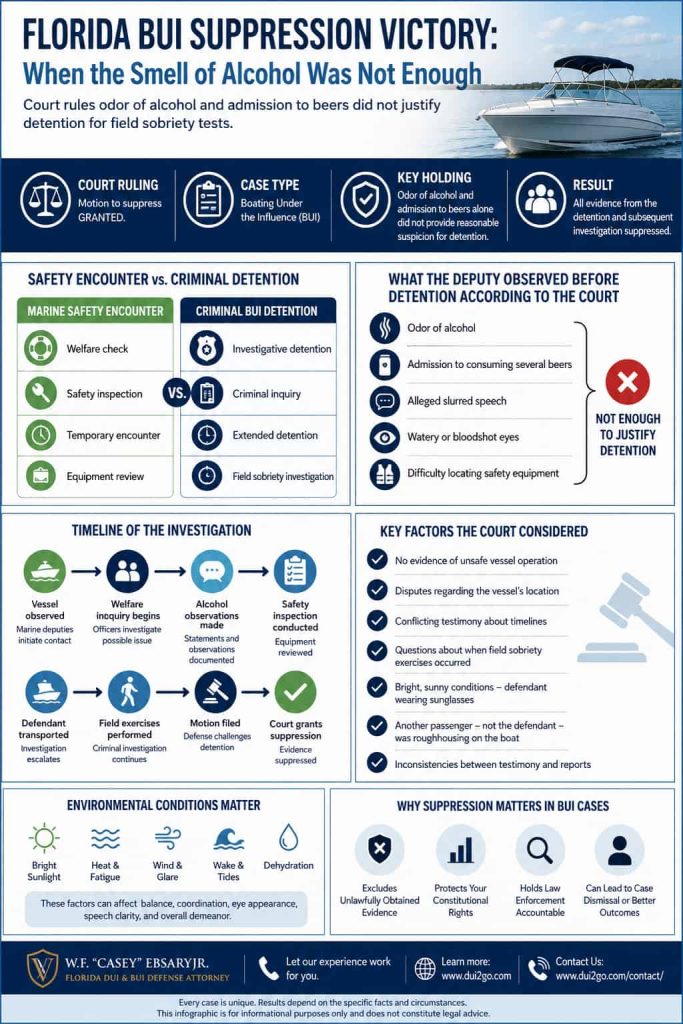
According to the court’s written order, marine deputies observed a recreational vessel during a busy holiday boating weekend. Officers approached the vessel after observing it floating near navigational markers and initiated contact to determine whether there was a medical emergency or mechanical issue.
The encounter later evolved into a boating under the influence investigation.
During testimony, the investigating deputy stated that he observed:
- An odor of alcohol
- Alleged slurred speech
- Bloodshot or watery eyes
- An admission to consuming several beers
- Difficulty locating boating safety equipment
However, the court identified multiple inconsistencies between the deputy’s testimony and the written reports introduced during the hearing.
The court also noted several additional factors, including:
- No evidence of unsafe boating operation
- Disputes regarding the exact location of the vessel
- Conflicting testimony regarding timelines
- Questions about when field sobriety exercises actually occurred
- Environmental conditions involving bright sunlight and active waterways
- Confusion involving which passenger had been engaged in horseplay aboard the vessel
Ultimately, the court concluded that law enforcement lacked sufficient grounds to detain the defendant for further criminal investigation at the marina.
Why This Florida BUI Ruling Matters
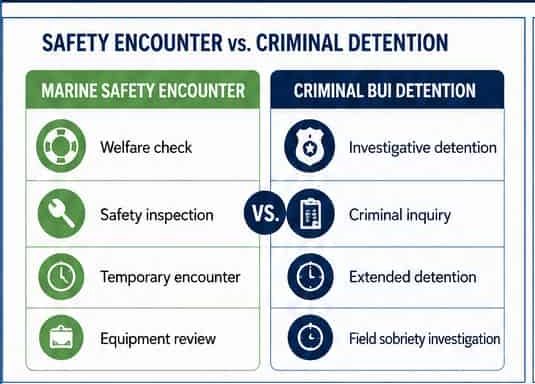
This case is significant because it distinguishes between:
| Marine Safety Encounter | Criminal BUI Investigation |
|---|---|
| Welfare check | Investigative detention |
| Safety inspection | Criminal inquiry |
| Temporary boarding | Extended detention |
| Equipment review | Field sobriety investigation |
The ruling demonstrates how courts may carefully analyze the point at which a consensual or administrative marine encounter becomes a criminal detention requiring additional legal justification.
Common Issues in Florida Boating Under the Influence Cases
Environmental Conditions Matter
Marine environments differ substantially from roadside DUI investigations.
Boaters are frequently exposed to:
- Heat
- Wind
- Bright sunlight
- Water glare
- Wave motion
- Fatigue
- Dehydration
These conditions may affect physical appearance, balance, coordination, and overall demeanor.
Vessel Movement Creates Unique Challenges
Unlike roadside DUI investigations conducted on stable ground, boating investigations occur in constantly moving environments.
Boat movement may affect:
- Balance
- Coordination
- Standing posture
- Eye appearance
- Walking performance
These issues often become important during litigation involving marine sobriety exercises.
Timeline of the Investigation
| Stage | Description |
|---|---|
| Vessel observed | Marine deputies initiate contact |
| Welfare inquiry begins | Officers investigate possible issue |
| Alcohol observations made | Statements and observations documented |
| Safety inspection conducted | Equipment reviewed |
| Defendant transported | Investigation escalates |
| Field exercises performed | Criminal investigation continues |
| Motion filed | Defense challenges detention |
| Court grants suppression | Evidence suppressed |
The Court Focused Heavily on Timing and Detention
One of the major issues discussed in the order involved the exact point at which the encounter became a detention.
The court determined that the detention occurred when the defendant was required to board a patrol vessel and travel to a marina for field sobriety exercises.
The ruling emphasized that the available evidence at that moment consisted primarily of:
- Odor of alcohol
- Admission to consuming beers over an unspecified time period
The court concluded that additional indicators of impairment were insufficiently established before the detention occurred.
No Evidence of Unsafe Vessel Operation
Another major issue involved the absence of dangerous boating behavior.
The court noted there was no substantial evidence of:
- Reckless operation
- Dangerous navigation
- Excessive speed
- Collision avoidance issues
- Erratic maneuvering
The absence of poor vessel operation became an important consideration in the suppression analysis.
Why Inconsistencies Matter in BUI Hearings
Suppression hearings frequently focus on credibility and consistency.
In this case, the court referenced:
| Issue | Importance |
|---|---|
| Conflicting timelines | Impacts reliability |
| Report discrepancies | Affects credibility |
| Passenger confusion | Clarifies observations |
| Location disputes | Impacts legal analysis |
| Investigation sequence | Determines legality |
Even relatively small discrepancies may become significant in contested boating investigations.
Florida BUI Cases Are Highly Fact Specific
Every boating under the influence investigation involves unique factual circumstances.
Important issues may include:
- Water conditions
- Tide movement
- Weather
- Vessel size
- Passenger activity
- Visibility
- Duration of stop
- Officer observations
- Video evidence
- Witness testimony
Because boating environments differ substantially from roadway investigations, courts often examine marine cases very closely.
A boating under the influence arrest may involve:
Criminal court proceedings
Vessel towing
Evidence review
Video analysis
Witness interviews
Suppression litigation
Negotiations or trial preparation
In some cases, motions challenging the legality of the detention or investigation may become central to the defense.
Important Questions Often Raised in BUI Cases

Marine officers may conduct certain boating safety inspections and welfare checks under circumstances different from roadway traffic stops.
Courts often analyze the precise moment an encounter transformed into a criminal investigation.
The timing and reliability of officer observations frequently become important issues.
Heat, sun exposure, water movement, and fatigue may affect physical appearance and performance.
Why Experienced BUI Defense Matters
Boating under the influence cases frequently involve:
- Technical legal issues
- Marine patrol procedures
- Timeline reconstruction
- Officer credibility disputes
- Video evidence review
- Suppression motions
- Environmental explanations
An experienced BUI defense attorney may carefully analyze every aspect of the investigation.
Contact W.F. “Casey” Ebsary Jr.

If you or a loved one has been arrested for boating under the influence in Florida, early investigation may be critical.
Learn more about my background here:
About Casey Ebsary Jr.
Contact my office here:
Contact DUI2GO
Visit:
DUI2GO.com
Frequently Asked Questions About Florida BUI Cases

Boating under the influence generally involves allegations that a person operated a vessel while impaired by alcohol or controlled substances.
Marine officers commonly conduct boating safety and welfare inspections on Florida waterways.
Yes. Boating cases often involve environmental conditions and vessel movement not present during roadside DUI stops.
Field sobriety exercises and related investigative procedures may become contested issues in litigation.
No. Courts evaluate the totality of the circumstances presented in each case.
The timing of observations, detentions, and investigative steps may affect whether evidence is admissible.
Environmental boating conditions may impact appearance and physical performance.
Written reports are often compared against testimony during hearings and trials.
Many boating cases focus on whether sufficient evidence existed to justify detention or arrest.
Early review of evidence, videos, reports, and witness statements may be important in building a defense.
TEXT OF OPINION
Online Reference: FLWSUPP 2712CRAG
STATE OF FLORIDA v. CHAD CRAGO, Defendant. County Court, 6th Judicial Circuit in and for Pinellas County. Case No. 19-08343 MMANO-G. January 7, 2020. Kathleen T. Hessinger, Judge. Counsel: Alexis Wilt, for State. J. Kevin Hayslett, Carlson, Meissner, Hart & Hayslett P.A., for Defendant.
ORDER GRANTING MOTION TO SUPPRESS
This Cause came to be heard before this Court on Defendant’s Motion to Suppress with Assistant State Attorney, Alexis Wilt, Esq., present with Defendant present, represented by counsel, Kevin Hayslett, Esq., and this Court having heard testimony, received evidence, and being otherwise advised of the premises, it is hereby Ordered and Adjudged as follows,
- On May 25, 2019, Defendant was charged with boating under the influence.
- On August 12, 2019, Defendant filed a Motion to Suppress alleging the deputy unlawfully stopped the boat and lacked reasonable suspicion to detain Defendant for a BUI investigation. At the time of the hearing on the Motion to Suppress, Defendant focused the issue only on the lack of reasonable suspicion to detain Defendant for the BUI investigation.
Facts - The State called Deputy Jimmy Nettles from the Pinellas County Sheriff’s Office to testify and then the Defendant testified.
- Deputy Nettles testified that he has been a deputy for 20 years, 16 years with the Nassau County Sheriff’s Office and 4 years with the Pinellas County Sheriff’s Office. He is currently assigned to the Marine and Environmental Land Unit.
a. On May 25, 2019, Deputy Nettles was on marine patrol, with Corporal Randy Hart, patrolling the intercoastal waterway between Dunedin Marina and the Dunedin Causeway. He testified that this was a busy holiday weekend. During his patrol, he observed a boat floating between the channel markers, near the west side of the markers. When he first observed the boat, he saw a female “mount” another female at the back of the boat and then a male “mount” the second female. Upon the deputy turning his patrol boat around, to approach the floating boat, the deputy testified that he observed the male get off the female and go to the helm of the boat to power it up to move it away.
b. Deputy Nettles testified that he stopped the boat as a boat cannot float in the channel unless a mechanical or medical problem exists, pursuant to §327.44(2), Fla. Stat. He further testified that approximately 20-30 boats were in the vicinity of this boat. He stated that outside the channel markers the water was between two (2) to five (5) feet depending on the tide at the time. He could not remember the status of the tide at the time of this incident. Deputy Nettles testified that he approached the boat due to it floating in between the channel markers. He needed to determine if any person on the boat had a medical problem or whether the boat had a mechanical issue.
c. Upon tying the patrol boat to the floating boat, the deputy spoke with the person at the helm of the boat: that person was identified as the Defendant in this matter. Upon speaking with the Defendant, the deputy testified that the Defendant had slurred speech and watery bloodshot eyes. He asked the Defendant if he had been drinking and he advised yes, four (4) beers. The deputy also saw an open can of alcohol near the Defendant. The deputy did not notice any issues with the Defendant’s balance; the deputy testified that the Defendant’s balance was not terrible considering the rocking of the boat from the wake of the other boats. Upon making sure no medical or mechanical issues existed, the deputy began a safety inspection of the boat.
d. The deputy testified that he asked Defendant if he owned the boat; the Defendant responded that he owned the boat. The deputy further testified that the Defendant had a hard time locating the requested items for the safety inspection. The deputy requested the vessel registration, the horn or whistle, life jackets, and “throwables.” The other people on the boat were trying to help him locate the items, but the deputy told them they could not do so.
e. Deputy Nettles testified that based on his observations of the Defendant, he was concerned that Defendant was possibly impaired. He had the Defendant step onto the patrol boat to isolate him from the other passengers as the other three (3) adults also appeared impaired; the two (2) children on the boat were not impaired. Upon isolating the Defendant from the other passengers, the deputy noted a strong odor of alcohol on the Defendant. Deputy Nettles testified that he performed HGN on the Defendant when he brought him onto the patrol boat; the Defendant had clues of impairment. At this time, the deputy towed Defendant’s boat to the Dunedin Marina as none of the adults on the boat were capable of operating the boat, based on their impairment, and he could not leave the boat in the channel. At the marina, the deputy performed field sobriety exercises in the parking lot of the marina. The field sobriety exercises were performed at the marina as the deputies had a camera to video tape the exercises.
f. On cross-examination, Deputy Nettles testified that he stopped the boat at approximately 3:00 p.m. Defendant’s boat was facing south and the deputy was patrolling north when he observed the Defendant’s boat floating in the channel. He did not write a citation for the violation of §327.44(2), Fla. Stat. The deputy confirmed that he stopped the boat solely to find out if the boat was anchored in the channel or had a mechanical issue. He further confirmed that when he pulled his patrol boat up to Defendant’s boat that Defendant was in the back of the boat and then walked to the helm of the boat. The Defendant was not at the helm of the boat when the deputy initially past the boat. At this time, the Defendant’s counsel showed Deputy Nettles a photo of the two ladies and one man lying on top of each other. The deputy then agreed that the man lying on top of the ladies was not the Defendant, it was a different man. He confirmed that the person at the helm of the boat was the Defendant and agreed he could not have seen the Defendant get off the ladies and walk to the helm of the boat as the Defendant was not the male laying on the ladies. At the time of the stop, the deputy did identify the driver of the boat as Chad Crago, the Defendant.
g. Deputy Nettles further agreed, according to his report, that when he made contact with the driver of the boat, he immediately detected an odor of alcohol and Defendant admitted to four (4) beers. Deputy Nettles agreed that, at that point, the odor of alcohol and the four (4) beers is what he had as signs of impairment prior to Defendant being detained on the patrol boat. The report reflects that the deputies then towed the boat to the Dunedin Marina wherein the full criminal investigation was conducted. Deputy Nettles agreed that his report reflects that the criminal investigation, at the marina, began at 1700 hours, 5:00 p.m. The report reflects the HGN, the one leg stand, and the walk and turn field sobriety exercises were performed at the marina. The field sobriety evaluation form reflects signs of impairment of bloodshot, glassy eyes, slurred speech, and odor of alcohol.
h. On cross-examination, the deputy was then asked what occurred between 3:00 p.m. and 4:30 p.m. as the deputy initially stated that the stop was at 3:00 p.m. The deputy then advised that the stop was at 5:00 p.m. He testified that the safety check lasted 5 minutes and the marina was one (1) mile away: thus, the tow took about 20 minutes. The criminal investigation began at approximately 5:30 p.m. and the field sobriety exercises concluded at about 5:45 p.m.
i. Deputy Nettles then confirmed that the signs of impairment he noted at the time the Defendant was on the boat was odor of alcohol and four (4) beers. He agreed that no other signs of impairment were noted before the dock. He further agreed the odor of alcohol is not a sign of impairment. He also agreed that drinking alcohol is not a sign of impairment and he did not ask how long the Defendant had been drinking. - The State did not call any other witnesses, so then the Defendant testified.
- The Defendant testified that the boat involved in this matter belongs to his fiancée. Throughout his testimony, wife and fiancée were being used interchangeably.
a. The Defendant testified that the boat was not between the channel markers when the marine patrol stopped the boat. The Defendant testified that the boat was on the outside of the channel markers about 100 yards to the west. He stated that the ladies had to use the restroom, so he went outside the channel markers, turned off the motor and the ladies went into the water. The tide was at high tide and the boat was floating. As the ladies returned on the boat, one lady laid down and the other lady jumped on top of her. Immediately thereafter, the other man on the boat jumped on top of the two of them; they were rough housing. A photo was taken of the three laying on top of each other right before they noticed the marine patrol approach. The Defendant testified that he was sitting in the captain’s chair with it turned facing to the back of the boat. He testified that he never saw the patrol boat approach, so he never got up to walk to the helm, he was already seated as described. The photo does not show any channel markers, but it does show that the wake from another boat is quite a bit off the backside of the boat at issue in this matter.
b. When the deputies pulled up to the boat, the Defendant testified that the deputy told him to shut down the boat and he advised the deputy that the boat was not running. The Defendant testified that he was not operating the boat; he spun around in the chair when the deputies approached the boat. He further advised that he never told the deputy he was operating the boat and his fiancée advised the deputy that the boat was her boat.
c. The Defendant further testified that the boat is a 23-foot boat and, prior to the Defendant being brought on the patrol boat, he was never within 5 feet of the deputy. Moreover, May 25, 2019 was a bright sunny day and he had sunglasses on when the deputies approached the boat. Another photo was introduced into evidence showing that the other three adult passengers were wearing sunglasses and the day was bright and sunny, no clouds in the sky. The Defendant further testified that he was told to board the patrol boat, to leave his sunglasses with his fiancée, and the deputy handcuffed him prior to boarding the patrol boat. - This Court finds inconsistencies exist between the testimony of the deputy and the police report prepared by the deputy. It appears that the deputy did not fully review his police report and field sobriety exercise evaluation form prior to testifying in this matter. Based on the direct examination and the cross examination of the deputy, this Court finds that the competent, substantial evidence proves that the deputy noticed the odor of alcohol on Defendant while Defendant was on the boat and the Defendant advised the deputy that he had four (4) beers. This Court finds the Defendant’s testimony that he was wearing sunglasses is credible based on the photo of the clear, bright, sunny day. Moreover, no evidence exists of any “bad” operating of the boat. The evidence proved that the Defendant was not the person roughhousing on the back of the boat. The photo of the location of the boat in relation to the channel markers is not dispositive of whether the boat was within or outside of the markers; however, the boat is clearly on the far side of the channel. Based on the credibility of the evidence presented, this Court cannot find that the State presented competent, substantial evidence that the Defendant’s boat was floating within the channel markers. The evidence proves that no field sobriety exercises were performed on the Defendant while he was on the patrol boat, including HGN. The deputy’s testimony, after his review of his report, reflects the HGN, one leg stand, and the walk and turn field sobriety exercises occurred at the parking lot of the marina. The deputy testified that the Defendant had a difficult time finding the safety inspection items requested by the deputy, but he did not testify as to whether he believed that was a result of Defendant being impaired. He actually agreed, on cross examination, that the only two signs of impairment he observed of the Defendant on the boat was the odor of alcohol and the admission to four (4) beers.
Legal Analysis
Although the Defendant does not agree that his boat was unanchored within the channel markers, he is not contesting the stop in this matter as the marine patrol has a much lower legal standard for stopping a boat then a street patrol officer has for making a stop of a vehicle. The question herein is whether Deputy Nettles had the legal basis to detain the Defendant to conduct a boating under the influence investigation. The Defendant was detained upon the deputy requiring him to board the patrol boat and travel in the patrol boat to the marina for field sobriety exercises. The competent substantial evidence proves that the Deputy’s evidence of impairment as to the Defendant consisted of the odor of alcohol and the admission of consuming four (4) beers over an unknown period of time.
In Ameqrane v. State, 39 So. 3d 339 (Fla. 2d DCA 2010) [35 Fla. L. Weekly D1148b], the Court addressed the requisite reasonable suspicion an officer must have in order to detain a driver to perform field sobriety exercises to determine whether probable cause exists to arrest for driving under the influence. In Ameqrane, an officer stopped the defendant for speeding at 4:00 a.m. Upon speaking with the defendant, the officer detected alcohol on his breath, and noticed that his eyes were bloodshot and glassy. The defendant also admitted he consumed alcohol. The officer had the defendant exit his vehicle and performed the HGN test on him. The HGN test reflected that the defendant’s eyes were “bouncing everywhere” depicting that the defendant was under the influence of alcohol. The officer then requested the defendant perform additional field sobriety exercises. Id. at 340. The defendant filed a motion to suppress alleging the officer lacked reasonable suspicion that he was impaired in order to request he perform the HGN or any other field sobriety exercise. Id. The Court held that to request that a driver submit to field sobriety tests, a police officer must have reasonable suspicion that the individual is driving under the influence. Id. at 341. The purpose of a DUI investigation is to either confirm or deny whether there is probable cause for a DUI arrest. Id. The Ameqrane Court held that the speeding at 4:00 in the morning, the signs of impairment, and the HGN results provided sufficient reasonable suspicion to ask the defendant to perform additional field sobriety exercises. (emphasis added) Id. at 342.
In Taylor v. State, 648 So. 2d 701, 703 (Fla. 1995) [20 Fla. L. Weekly S6b], the defendant drove at a high rate of speed, staggered upon exiting his vehicle, had a strong odor of alcohol on his breath, exhibited slurred speech, and had watery, bloodshot eyes. The Taylor Court ruled that these signs of impairment were more than enough to provide the officer with reasonable suspicion that a crime was committed, i.e. DUI. Id. at 703. The Court held that the officer was entitled to conduct a reasonable inquiry to confirm or deny that probable cause existed to make an arrest. Id. As such, the officer’s request that the defendant perform field sobriety tests was reasonable under the circumstances and did not violate any Fourth Amendment rights. Id. at 703-704.
Liefert v. State, 247 So. 2d 18 (Fla. 2d DCA 1971) also addressed the signs of impairment required to compel the driver to perform field sobriety exercises. In Liefert, the officer observed the defendant driving his panel truck in a weaving fashion across two lanes of traffic and pull over. When the defendant exited the truck, the officer approached him and asked for his driver’s license and noticed an odor of alcoholic beverage. The officer then asked the defendant to perform field sobriety tests for which he agreed. Id. at 19. The issue raised on appeal was whether the officer was required to advise the defendant that he had a right to either take the physical tests or refuse to take the tests. Id. The Court held that the officer, after having observed the defendant drive in a weaving fashion and then noticing the smell of alcohol on his breath, had sufficient cause to believe that the defendant committed a crime in the operation of the motor vehicle and could require him to take part in such physical sobriety tests. Id.
The competent substantial evidence in this matter proves that prior to the Defendant being detained on the patrol boat, the deputy noted an odor of alcohol on Defendant’s breath and Defendant admitted to consuming four (4) beers. The deputy did not question Defendant as to what period of time he drank the four (4) beers. Based on the deputy’s testimony at the suppression hearing, he was initially confused as to whether he stopped the Defendant’s boat at 3:00 p.m. or 5:00 p.m.; however, the evidence appears to prove the stop was at 5:00 p.m. As such, the evidence proves, at some point throughout the day, the Defendant consumed four (4) beers. Based on the competent, substantial evidence this Court set forth in its factual findings and without any additional signs of impairment, the deputy did not have reasonable suspicion to detain the Defendant to perform field sobriety exercises. - It is therefore Ordered and Adjudged that Defendant’s Motion to Suppress is GRANTED.