- Free Consultation: 813.222.2220 Tap Here To Call Us




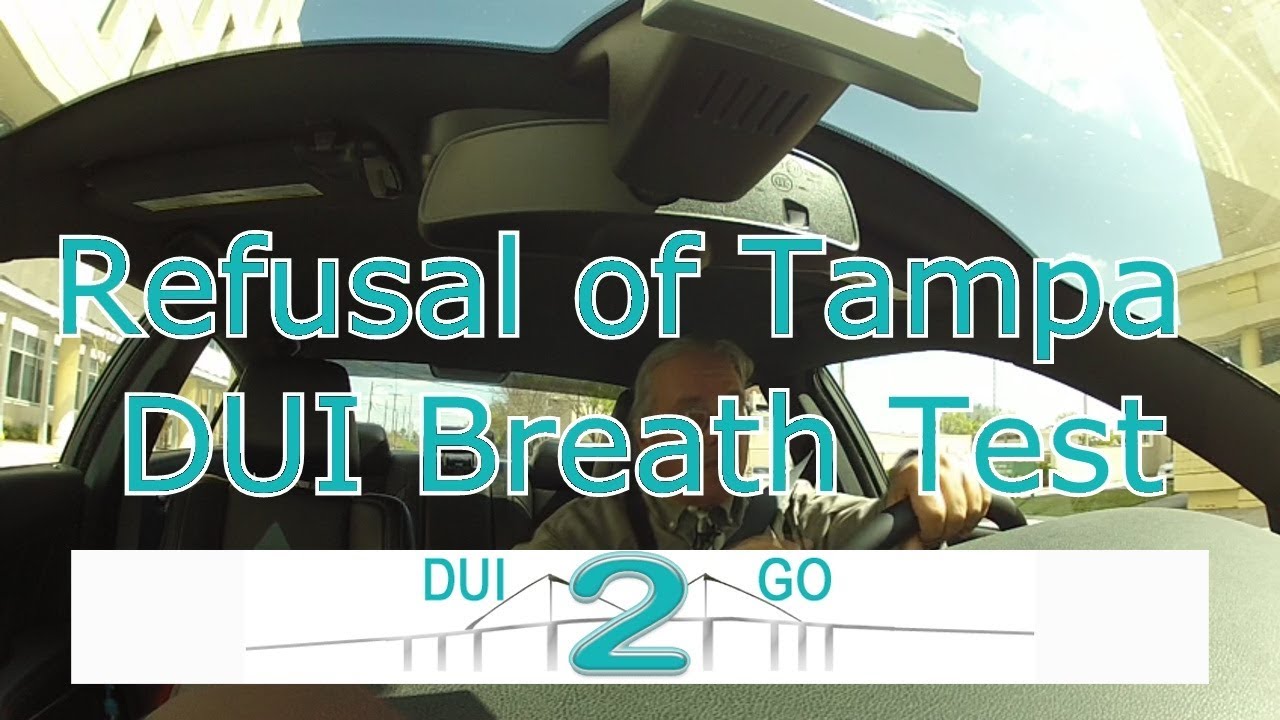
Video: Florida DUI Breath Test Refusal Video: Consequences Explained


Florida DUI: Understanding the Refusal of a Breath Test
An inside look at what happens when law enforcement reads Florida’s Implied Consent law during a DUI arrest.
When an individual is placed under arrest for driving under the influence (DUI) in Florida, law enforcement officers are required to read the state’s Implied Consent Law before administering chemical tests.
As demonstrated in the video footage from a standard law enforcement encounter, the formal warning highlights strict administrative and criminal penalties for refusing to submit to a lawful breath or urine test.
Key Consequences of a Test Refusal Outlined Under Florida Law
- First-Time Refusal: Driving privileges in the State of Florida will be suspended for a period of one year.
- Subsequent Refusal: Driving privileges will be suspended for a period of 18 months if the license has been previously suspended as a result of a prior refusal.
- Criminal Penalties: A refusal to submit to a lawful test becomes a first-degree misdemeanor if the driver’s driving privilege has been previously suspended as a result of a prior refusal.
- Right to Counsel Clarification: Under the Implied Consent framework read by law enforcement, the standard constitutional right to remain silent or to have a lawyer present before making statements does not apply to the physical execution of approved chemical breath or urine tests.
Video Transcript
My name Deputy St for Hillsborough County Sheriff’s Office. The time is now 20:05 according to my watch. What is your name please? Tell me your address and social security number if you have one.
And your Social Security… You’ve been placed under arrest and charged with driving while impaired. I’m going to read Florida’s implied consent law to you, listen carefully to what I am about to say.
Florida law requires that you take a chemical test to determine the alcohol content of your breath and a urine test for controlled substances. Should you refuse to submit to either or both of these tests, the driving privilege in the state of Florida will be suspended for a period of one year for a first refusal, or for a period of 18 months if your driving privilege has been previously suspended as a result of a refusal to submit to such test or tests.
Additionally, it is a first-degree misdemeanor to refuse to submit to either or both of these tests if your driving privilege has been previously suspended as a result of a prior refusal.
Your right to remain silent has nothing to do with taking the approved chemical tests for the purpose of determining the alcohol and drug content of your breath. Also, your right to have a lawyer present before you make any statement and during any questioning has nothing to do with taking approval tests for the purpose of determining the alcohol and drug content of your breath. Your right not to answer any questions has nothing to do with such approved chemical tests.
Do you understand? What will you take these tests? All right.
10 Critical Questions and Answers Regarding Refusal
By maintaining a driver’s license and operating a motor vehicle within the borders of this state, you have already legally agreed to submit to approved chemical testing. This compromise means that if an officer has lawful probable cause to arrest you for driving under the influence, you must take a breath or urine test when requested. I want to emphasize that this prior consent is a mandatory condition of enjoying your driving privileges, meaning you cannot claim surprise when an officer demands a compliance sample at the station. To understand how these expectations apply directly to your traffic stop, you can read my comprehensive guide on DUI Refusal in Florida.
If you choose to refuse a lawful breath, urine, or blood test for the very first time, the state will initiate an administrative suspension of your driving privilege for a continuous period of one year. I must clarify that this administrative penalty is handled entirely by the executive branch of our state government, meaning it proceeds forward even if your criminal charges are later dismissed by a judge. We can attempt to mitigate this outcome within the first ten days, but the statutory baseline remains a firm twelve-month suspension of your regular license. I explain this administrative timeline and its long-term impacts in detail on my video guide Florida DUI Breath Test Refusal Consequences Explained.
When a driver chooses to refuse chemical testing and has a prior refusal on their driving record, the state imposes a highly restrictive eighteen-month administrative suspension. I look at these cases with extreme urgency because you are no longer dealing with a simple administrative issue, as a second or subsequent refusal can dramatically complicate your defense. We cannot easily secure early hardship privileges in these repeat refusal scenarios, making the strategic handling of your administrative defense an immediate priority for our legal team. You can learn more about how prior offenses interact with new charges by reading my breakdown on What Happens With a Second DUI in Florida.
A refusal to submit to a lawful chemical test becomes an explicit first-degree misdemeanor criminal charge if your driving privilege has been previously suspended for a prior refusal. I tell my clients that this means you can be faced with two entirely separate criminal charges stemming from a single traffic stop: the underlying driving under the influence charge and the independent charge of refusing a lawful test. A conviction on this misdemeanor offense carries severe penal consequences, including a maximum sentence of up to one year in a county jail facility. To discover the legal pathways we use to contest these dual prosecutions, you can read my resource on DUI Refusal to Submit to Chemical Test.
Yes, the state prosecutors are legally allowed to introduce your refusal into evidence at your criminal trial to argue that you demonstrated a “consciousness of guilt.” I regularly prepare juries for this tactic because prosecutors will explicitly tell the panel that you declined the test simply because you knew your blood-alcohol level exceeded the legal limit. We counter this specific argument by presenting alternative, entirely innocent explanations for why an individual might choose to reject a roadside or stationhouse chemical test. To see how we protect your rights against illegal burden shifting in front of a jury, read my deep dive on Florida DUI Refusal Trial Strategies.
The administrative suspension is triggered immediately by the Department of Highway Safety and Motor Vehicles based on the officer’s affidavit, while a court suspension only occurs if you are formally convicted of the DUI charge. I closely track both paths because a criminal conviction requires a mandatory court-ordered driver’s license revocation lasting anywhere from six months to a lifetime, depending on your prior record. Because navigating both the administrative and criminal tracks simultaneously is exceptionally complex, I highly recommend coordinating both defenses with an experienced specialist. To understand how we leverage the administrative phase to build leverage for your trial, read my presentation on Why to Hire a Private DUI Attorney in Florida.
We can absolutely launch a formal challenge against the suspension, provided that we submit a formal filing for a review hearing within exactly ten calendar days of your arrest date. I use these formal administrative hearings to cross-examine the arresting officers and verify whether they actually possessed the required legal standing to demand your breath sample in the first place. If we can successfully prove that the officer lacked probable cause for the initial traffic stop or failed to read the mandatory statutory warnings, the state must reinstate your driving privileges. You can read a complete breakdown of how we run these hearings on our Florida DUI DHSMV Formal Review Hearings Guide.
The physical paperwork or uniform boating/traffic citation issued to you by the officer serves as your official temporary driver’s license for exactly ten days following the date of your arrest. I remind everyone that this temporary permit contains strict geographic and functional limits, but it does legally allow you to drive for business or employment purposes while we structure your defense. Once those initial ten days elapse, the paper permit expires completely, and you cannot drive at all unless we have successfully secured an extension or a formal hardship license. To avoid missing this critical deadline, we outline the exact steps you need to take on our 10-Day Rule and Temporary Permits Page.
For a first-time refusal, you can choose to waive your right to a formal review hearing and request an immediate “Business Purposes Only” hardship license without serving any blackout period. I carefully analyze each client’s professional and personal situation to determine if this immediate waiver path is truly superior to fighting the case at a formal DMV evidentiary hearing. This waiver option is completely unavailable if you have a prior refusal on your record, meaning a second refusal locks you into a mandatory, unavoidable multi-month driving blackout. If you are facing a multi-year suspension, you may need to apply for the state-regulated program outlined in our guide on Florida DUI Special Supervision Services and Hardship Licensing.
The laws of our state do not grant you the right to speak with a defense lawyer before deciding whether to submit to a chemical breath, urine, or blood test. I must inform you with absolute certainty that requesting to call me or asking for a legal consultation at that specific moment will be logged by the officer as a final, legal refusal to cooperate. While you cannot halt the stationhouse testing process to seek my advice, you should contact my office the moment you are released so we can preserve your remaining constitutional rights. To see how these rules apply equally to average citizens and off-duty police officers, view my analysis on What Happens When Police Officers Are Asked to Take a Breath Test.
Direct Legal Support for Your License
If you or a loved one are facing the confusing aftermath of a DUI stop and an alleged test refusal, you cannot afford to let deadlines slip past. The state gives you a narrow ten-day window to protect your ability to drive to work, school, and medical appointments.
To learn more about my background, qualifications, and extensive history defending criminal trials across the state, you are welcome to read my professional biography on our About Casey the Lawyer page. When you are ready to have me review the specific facts of your police report and build an aggressive defense strategy for your administrative and criminal cases, please reach out directly through our Contact portal or call our office immediately at 813-222-2220.
Verifiable Legal Resources
- Official Florida Statutes: Review the exact text of the Florida Implied Consent Law Section 316.1932 on Justia to inspect how chemical tests are governed.
- Refusal Criminal Penalty Statutes: Read the criminal parameters via Florida Statute Section 316.1939 on Justia regarding the prosecution of subsequent test refusals.
- State Agency Portal: You can access the official administrative guidelines directly via the Florida Department of Highway Safety and Motor Vehicles Website.
Facing a DUI Charge or Breath Test Refusal in Tampa?
Every legal case involves distinct factors. If your driving privileges are at stake due to an implied consent refusal, timely intervention is critical.
- Learn more About Our Practice
- Contact Us Immediately to protect your license.
Call Casey at 813-222-2220